Revised 2026
Sheet 001
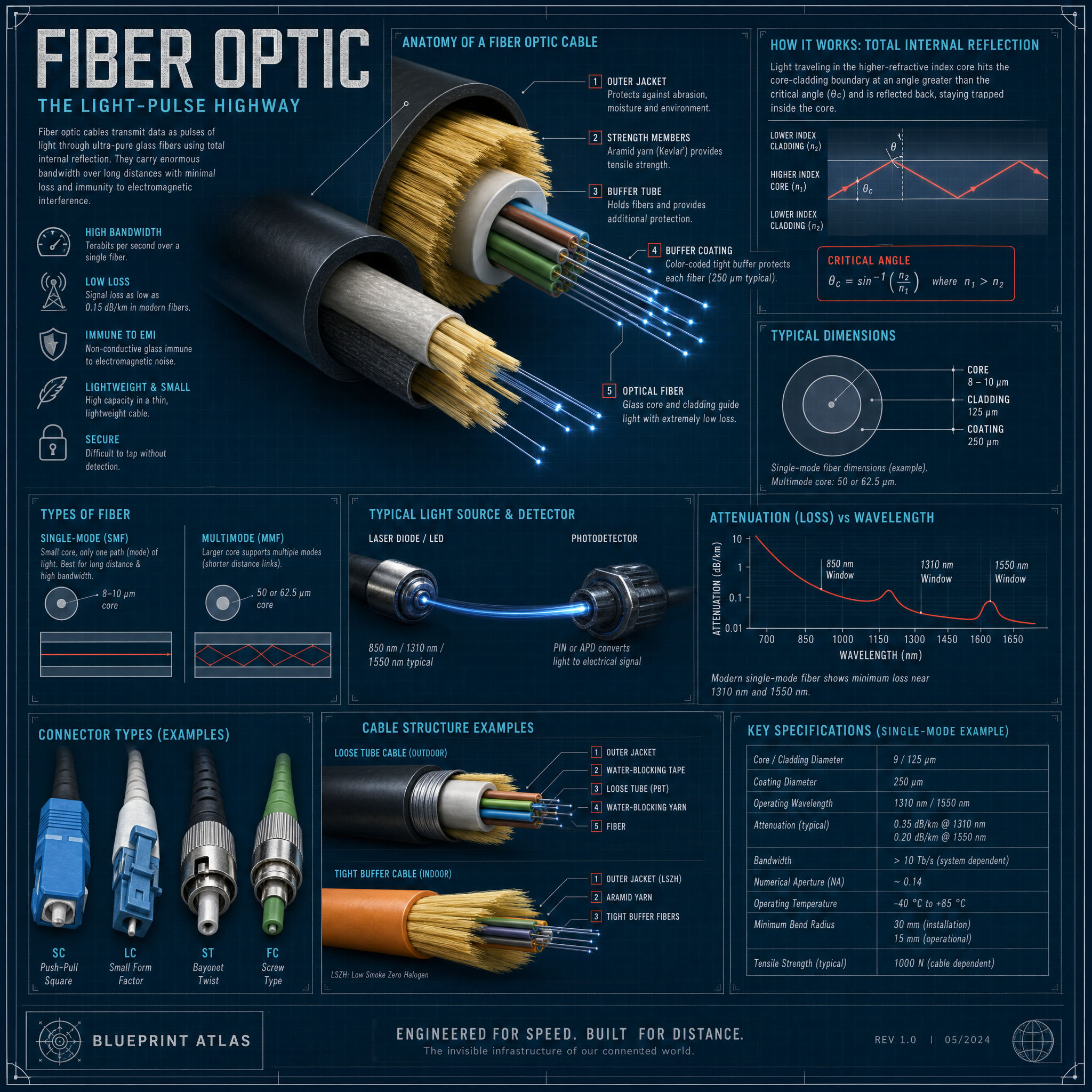
Fiber Optic
Light is trapped in an ultra-pure silica core by total internal reflection at the core/cladding boundary. Wavelength-division multiplexing stacks dozens of colours down a single strand, pushing terabits per second across continents on a glass thread thinner than a human hair.
Sheet 002
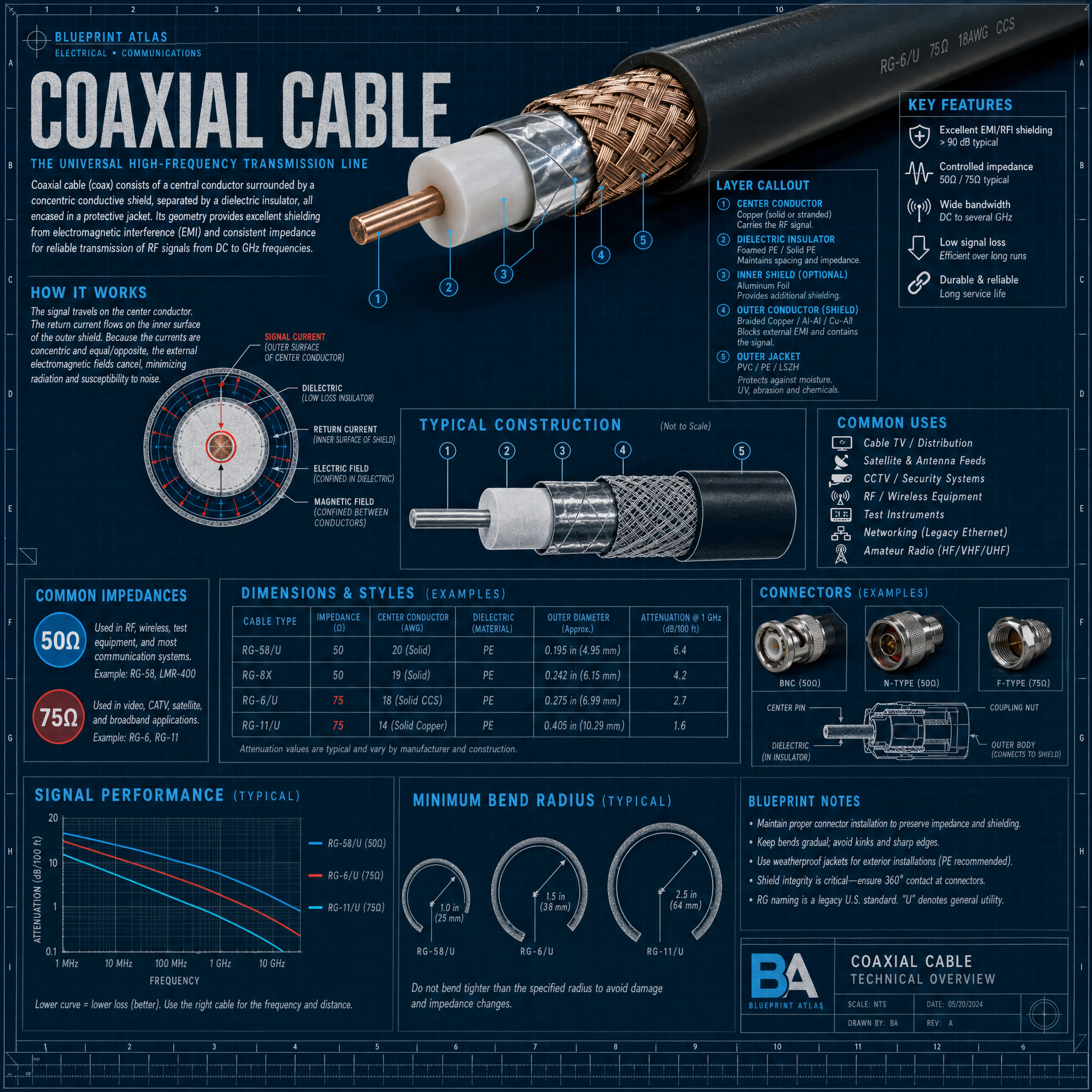
Coaxial Cable
A centre conductor sits inside a foam dielectric, wrapped by a foil-and-braid shield and a PVC jacket. The two conductors share an axis, so the entire electromagnetic field is confined between them — EMI stays out, the signal stays in, and characteristic impedance stays constant.
Sheet 003
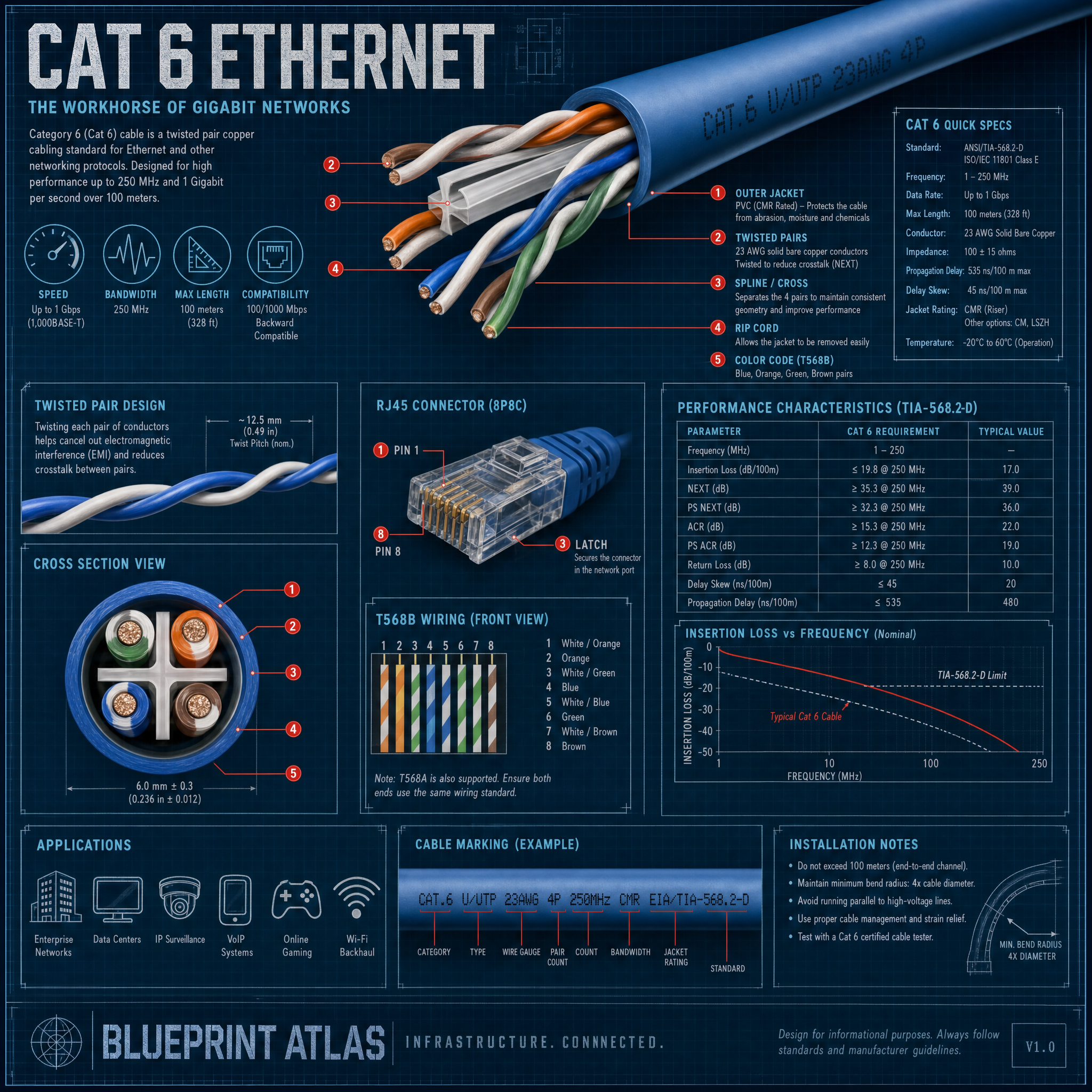
Cat 6 Ethernet
Four colour-coded pairs of copper, each pair twisted at a different rate to cancel external EMI and reduce crosstalk between pairs. Differential signalling means each lane carries equal-and-opposite voltages, so noise picked up by both wires cancels out at the receiver.
Sheet 004
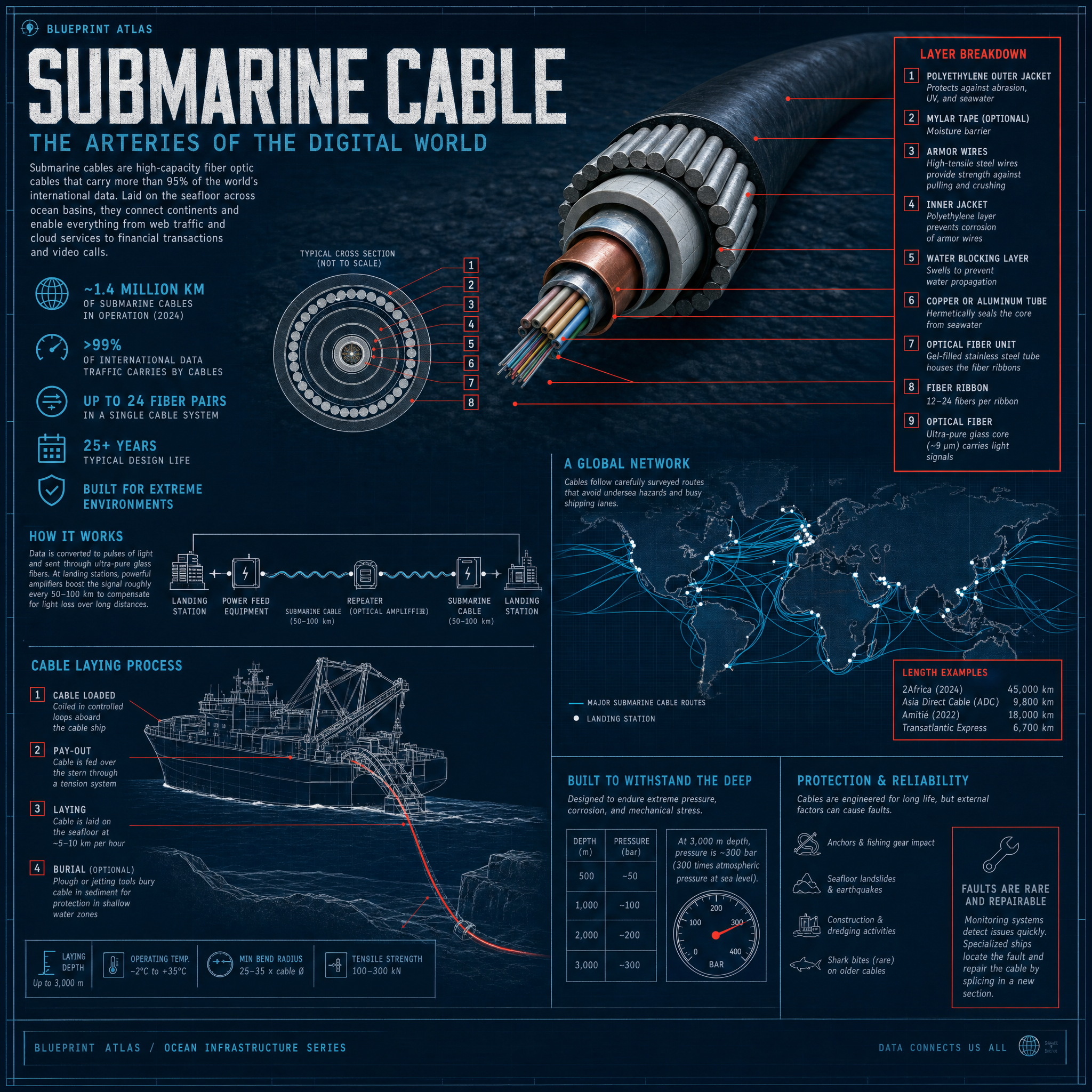
Submarine Cable
A handful of optical fibres at the centre, wrapped in copper for power, sealed in a hydrogen barrier, then armoured with steel wires for trawler and anchor strikes. Optical amplifiers (EDFAs) every ~70 km re-boost the signal across abyssal-plain depths up to 8 km.
Sheet 005
Power Transmission Line
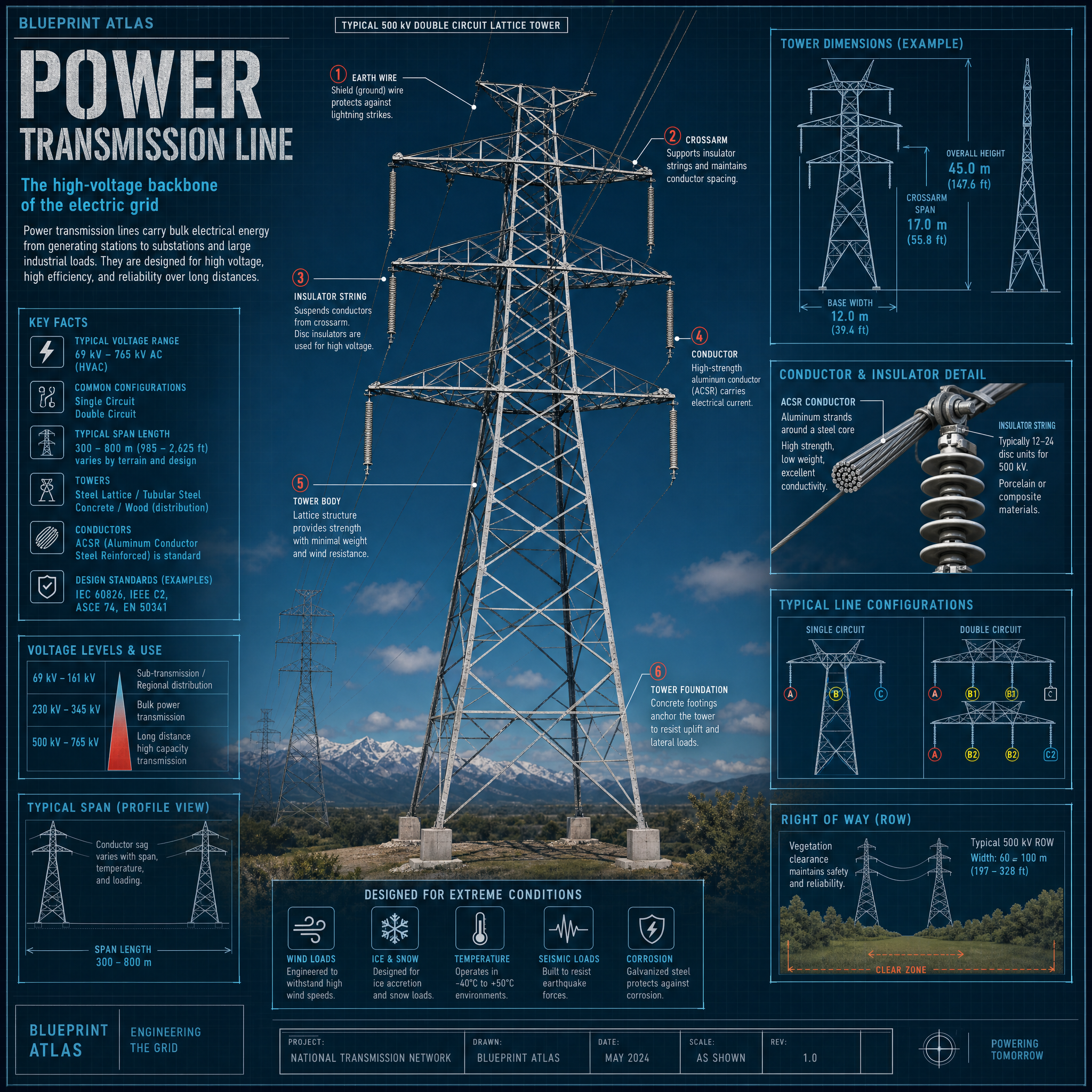
A galvanised steel core takes the mechanical load while concentric aluminium strands carry the current — cheaper and lighter than solid copper of the same ampacity. Phase conductors are bundled to lower surface field gradient and tame the corona discharge that wastes power and makes the lines hum.
Sheet 006
HDMI
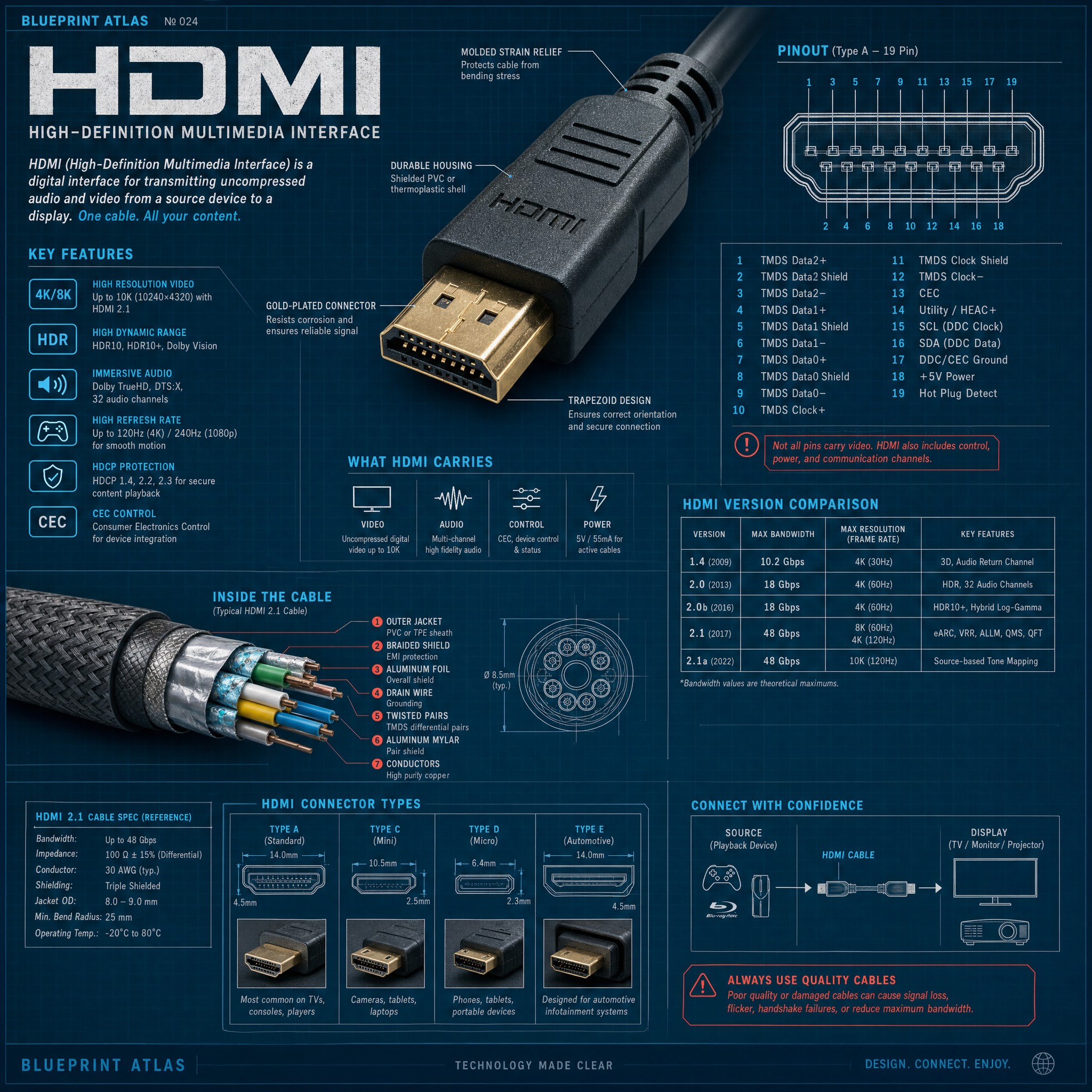
Three differential pairs carry video and audio data, a fourth carries the pixel clock, and a handful of side-channel pins handle CEC, ARC and EDID. Transition-Minimised Differential Signalling deliberately balances bit transitions to keep emissions low across the 19 conductors of a Type A connector.
Sheet 007
USB-C
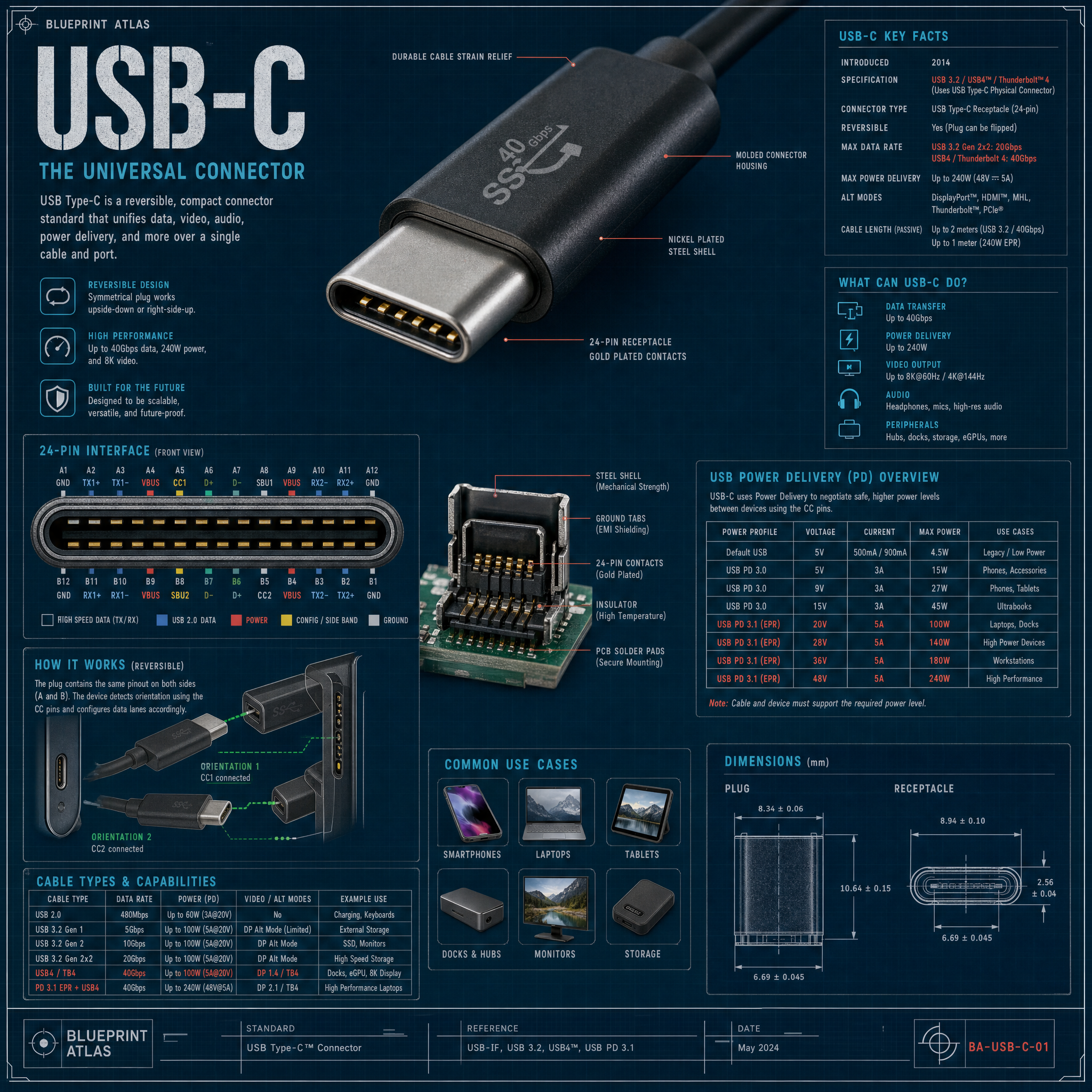
A symmetric 24-pin connector that figures out its own orientation through two Configuration Channel pins. Power Delivery negotiates voltage up to 48 V, while Alt Modes let DisplayPort and Thunderbolt tunnel through the same cable — one port that replaces a desktop’s worth of legacy connectors.
Sheet 008
XLPE Power Cable
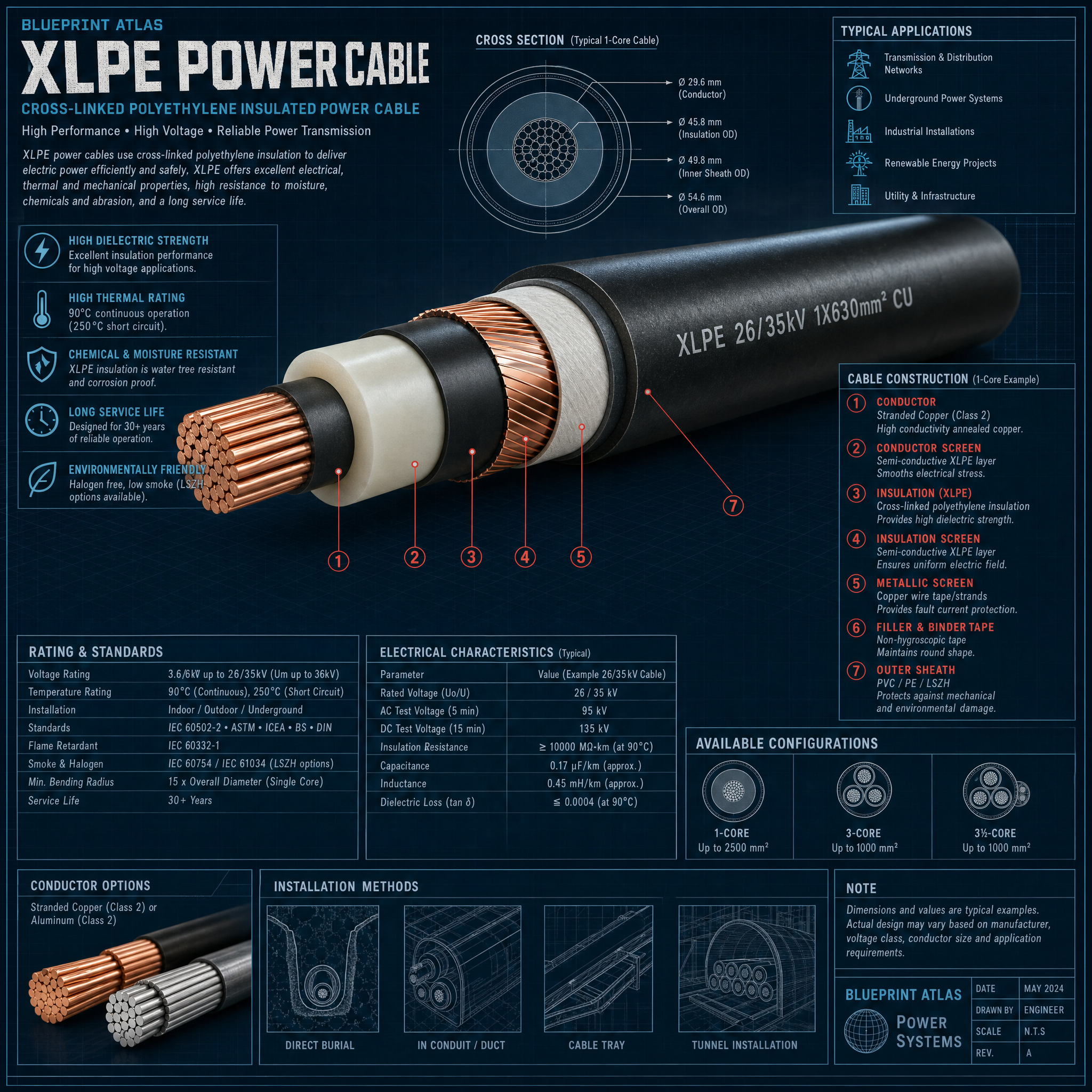
Three phase conductors are each wrapped in a semiconducting screen, a thick XLPE dielectric, another screen, then a copper wire shield, water-blocking tapes, steel-tape armour and an HDPE jacket. Cross-linking the polyethylene makes it thermoset — it doesn’t soften under fault-current heating.
Sheet 009
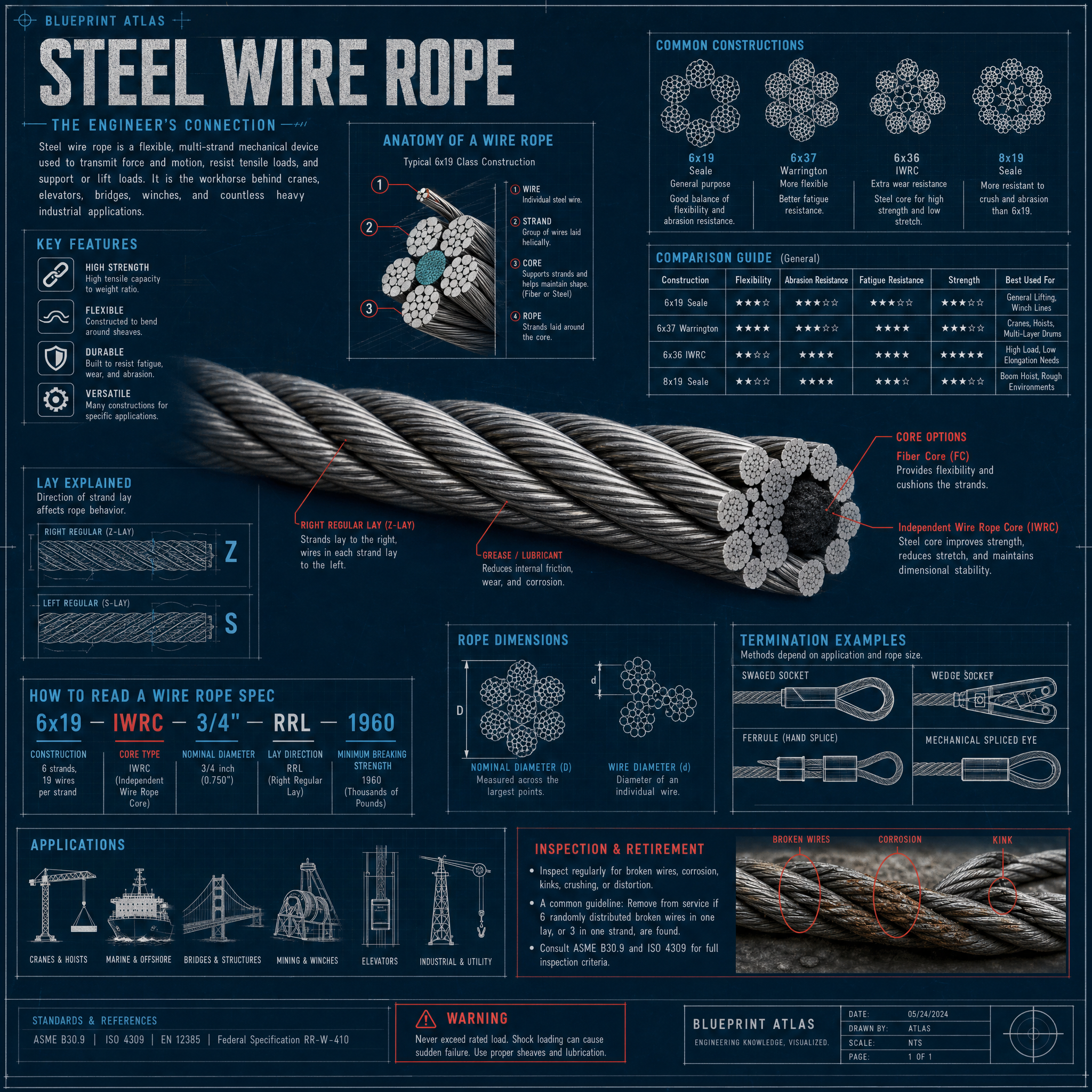
Steel Wire Rope
Cold-drawn high-tensile wires laid helically into strands, then strands laid into a rope around a core. The double helix lets the rope bend over sheaves while still loading every wire near-axially — the geometry is what makes a 1 m diameter cable hold a Pacific-spanning suspension bridge.
Sheet 010
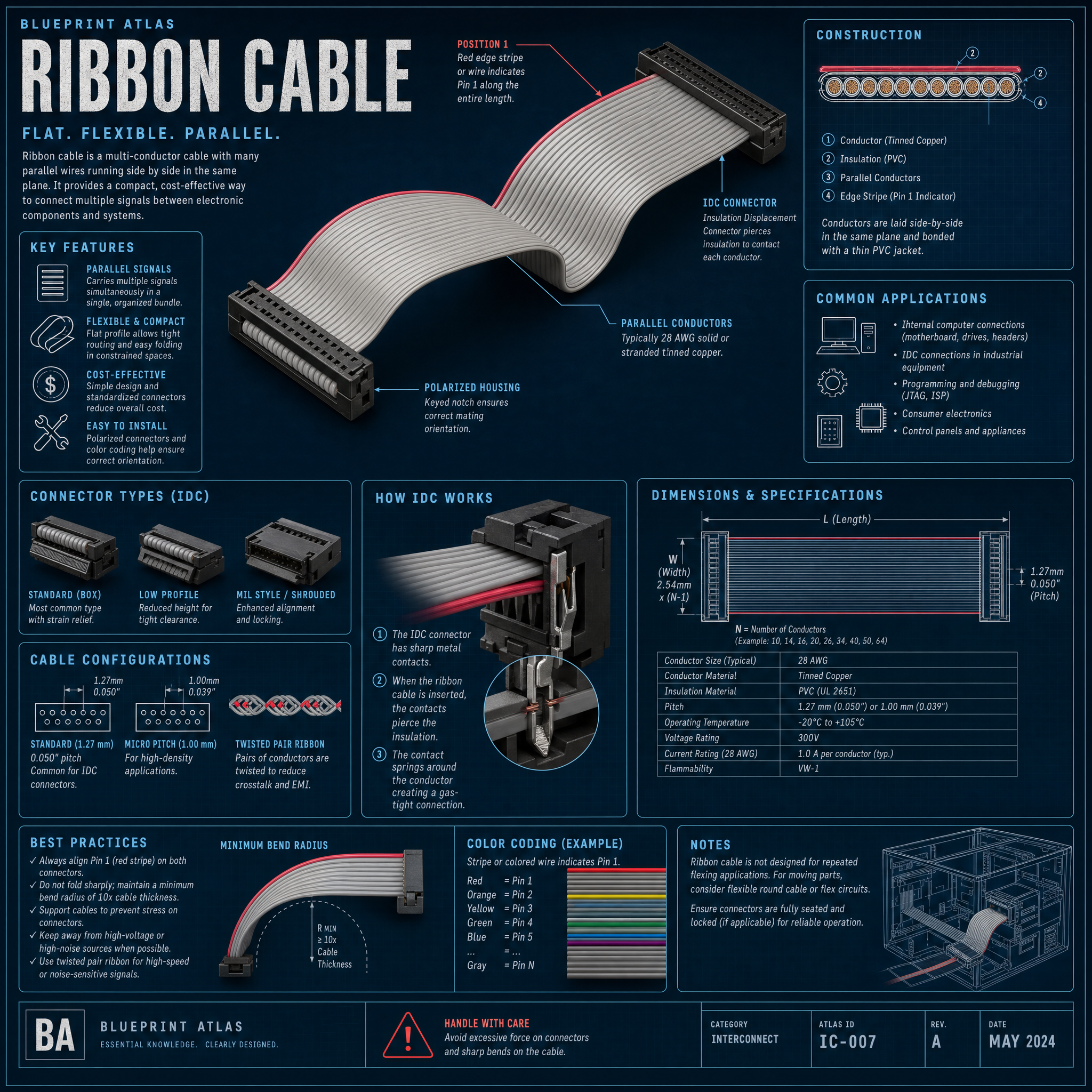
Ribbon Cable
Parallel solid-copper conductors laminated into a thin flat strip at fixed pitch, designed for mass termination through Insulation Displacement Connectors. Rainbow IDC ribbons populated 80s and 90s PCs; today’s amber FFC tape lives inside laptops, cameras and printers, threading signal where round cable can’t fit.