Revised 2026
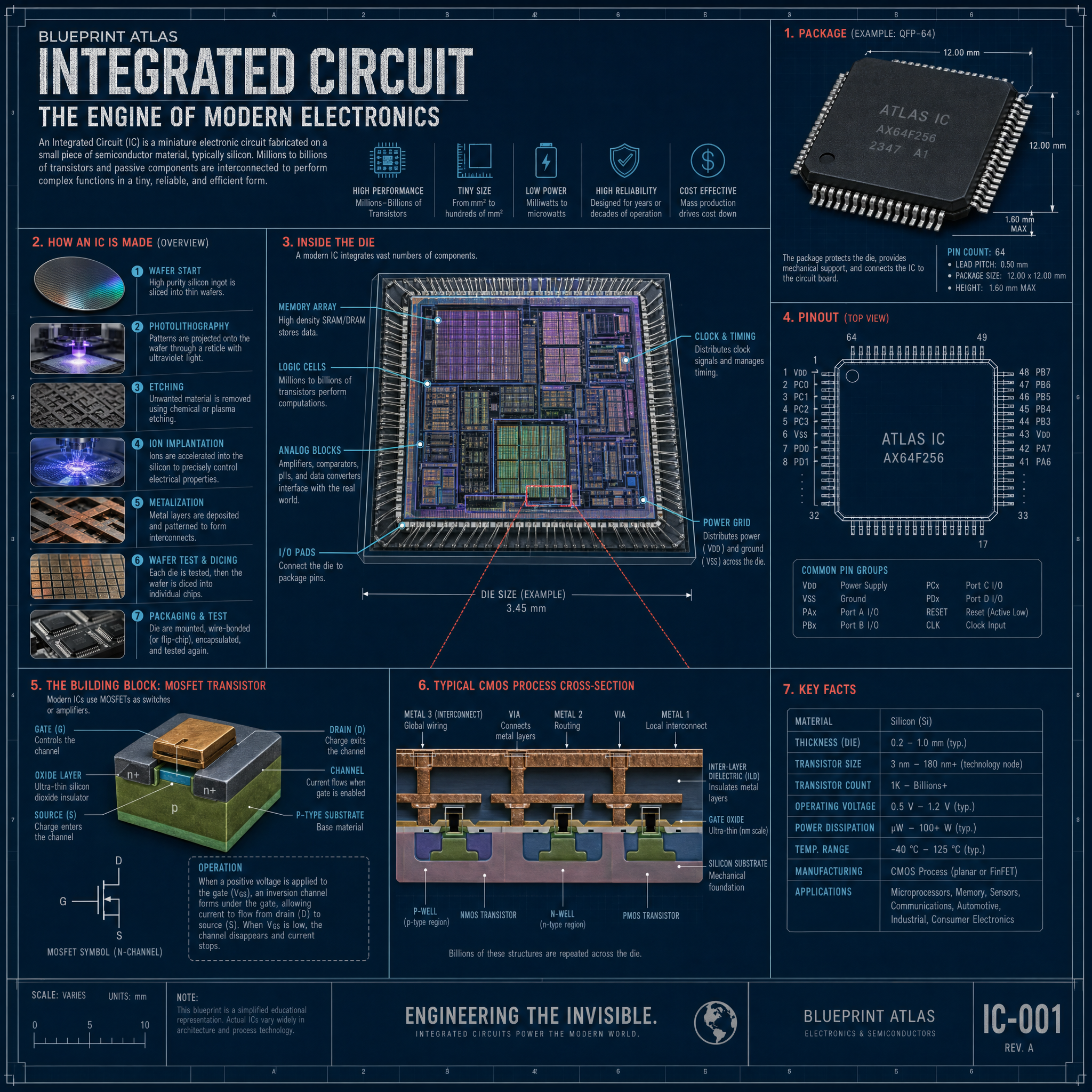
Sheet 001
Integrated Circuit
A monolithic block of doped silicon photolithographed into millions to billions of transistors, resistors and interconnect layers. Jack Kilby (TI) and Robert Noyce (Fairchild) independently solved the tyranny of numbers in 1958–59 — every modern processor, memory and microcontroller is a direct descendant. Moore’s law has driven feature size from ~10 µm to ~2 nm in six decades.
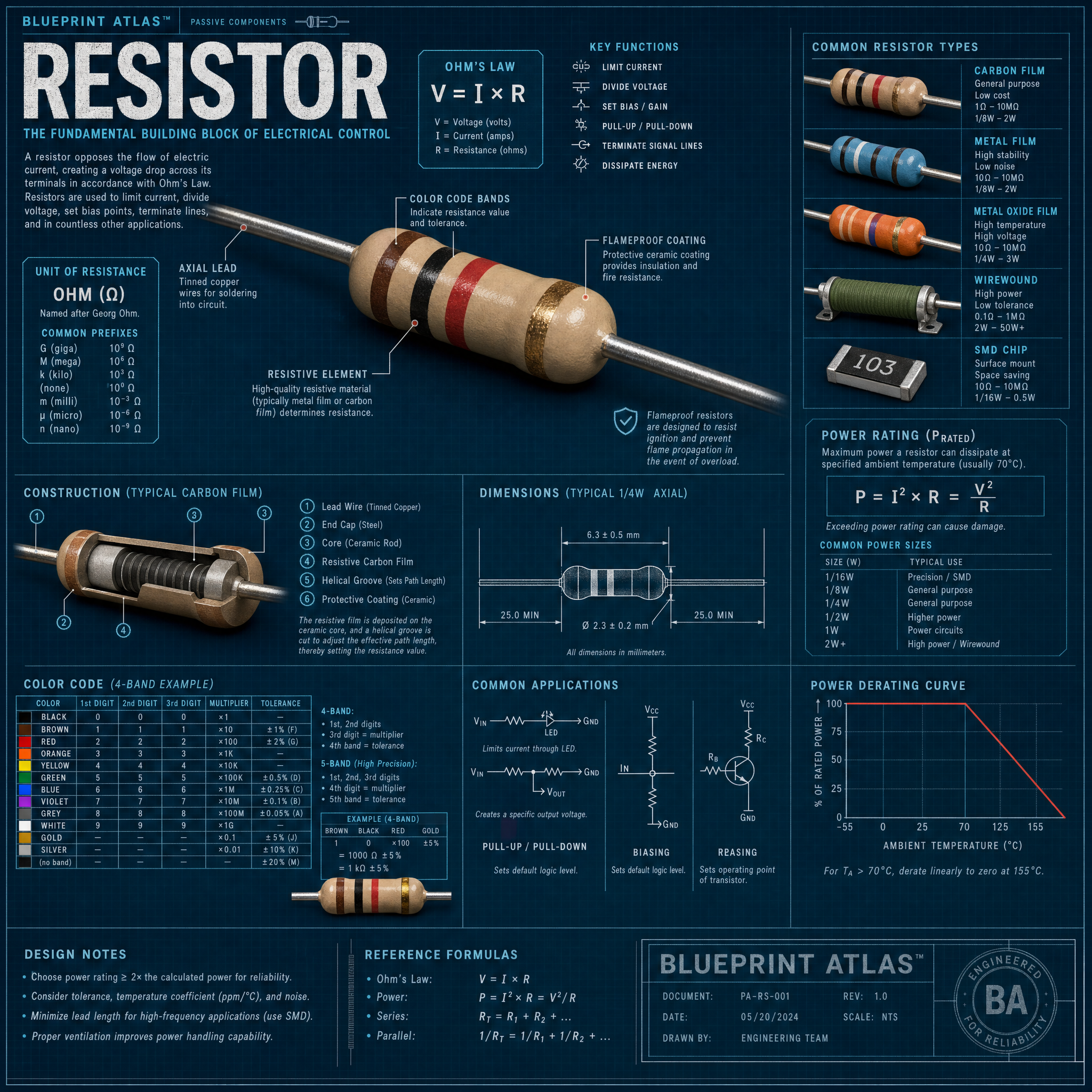
Sheet 002
Resistor
A controlled obstruction in a circuit, dissipating electrical energy as heat to set currents and divide voltages. A carbon-film or metal-film coating on a ceramic body trims the resistance via a helical laser cut; four or five colour bands encode the value, multiplier and tolerance. The simplest passive component — and still the one used most often.
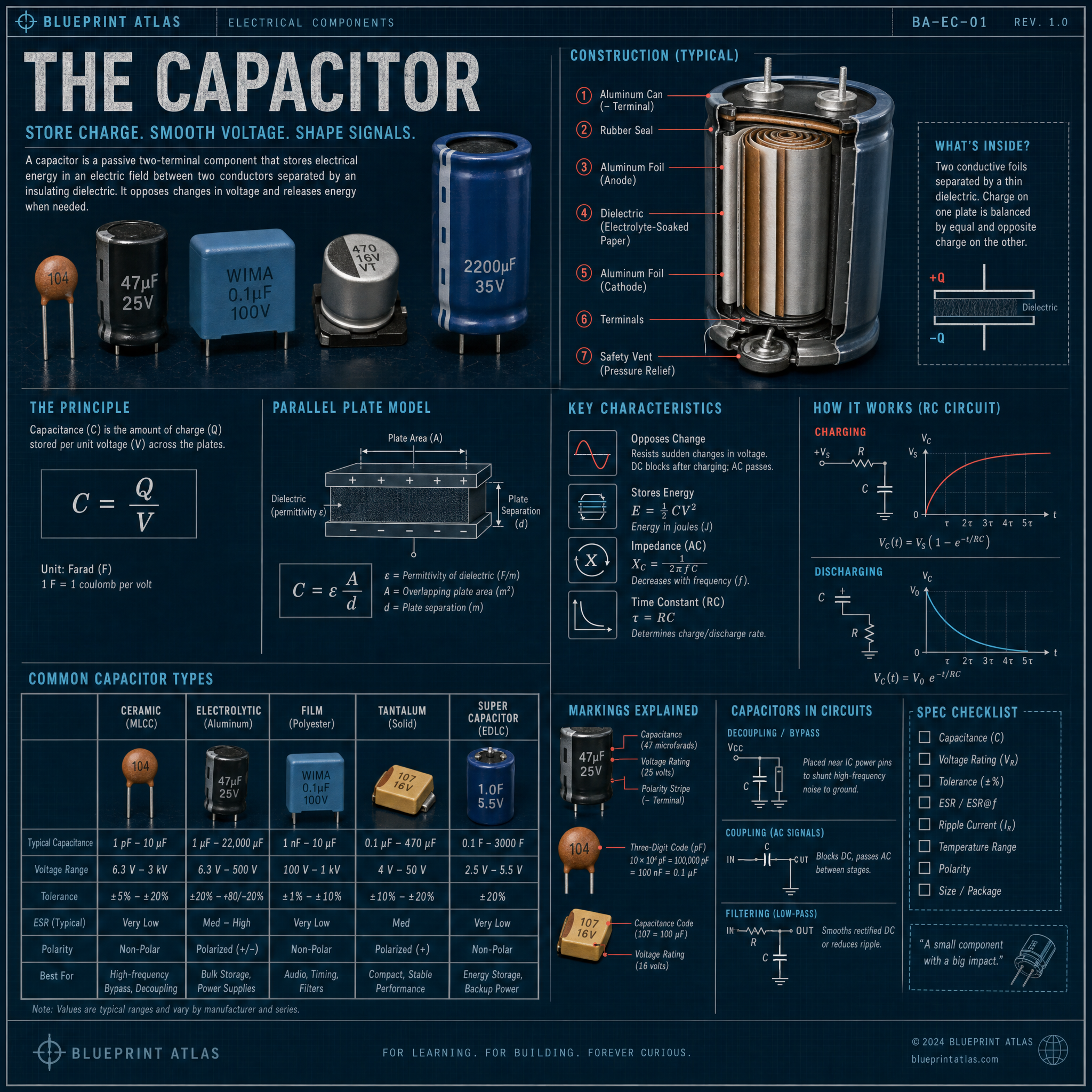
Sheet 003
Capacitor
Two conducting plates separated by a dielectric — apply a voltage and charge accumulates without crossing the gap. Capacitors smooth power supplies, couple AC signals, set timing constants with resistors, and store energy for camera flashes and EV regenerative braking. Working voltage and ESR matter as much as the capacitance value itself.
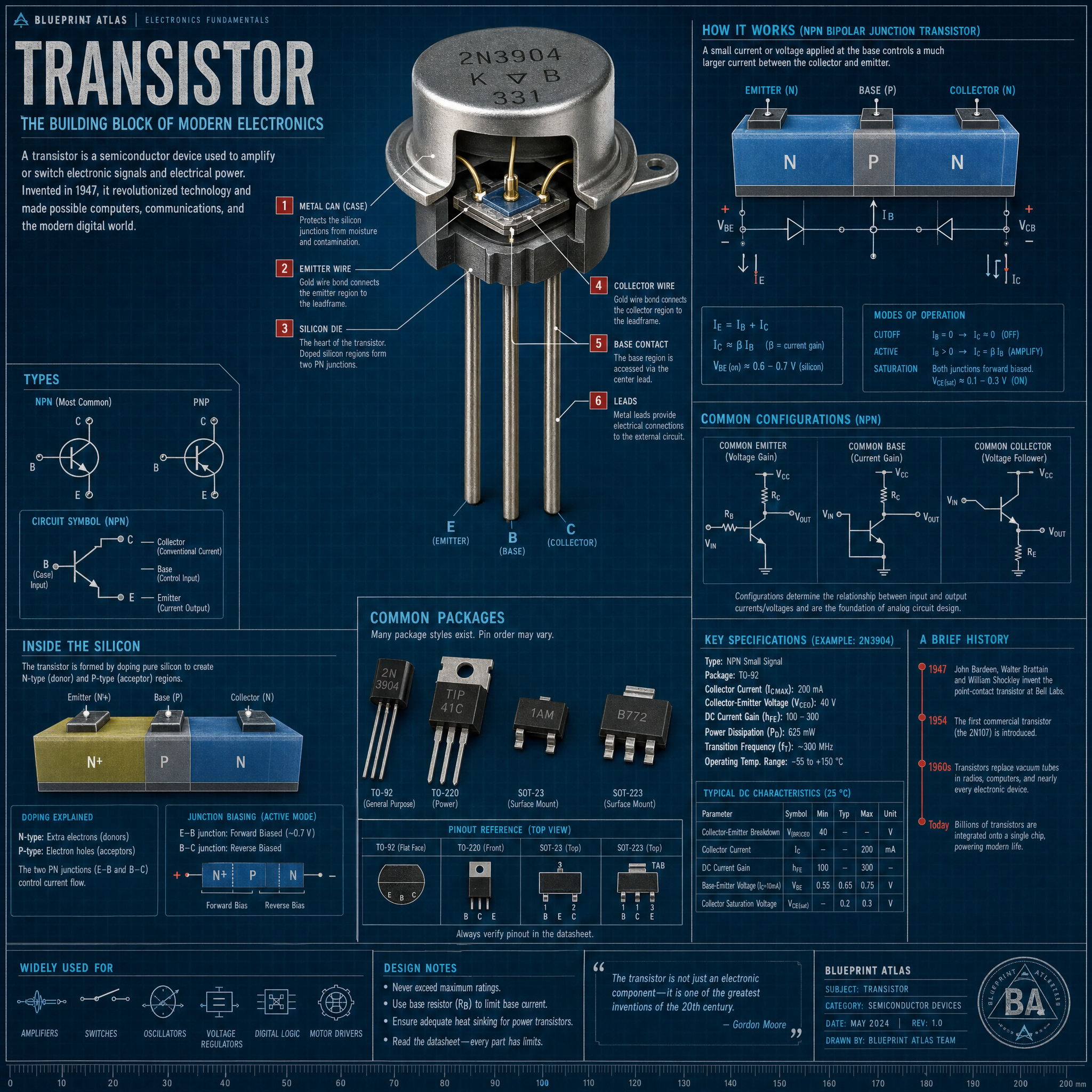
Sheet 004
Transistor
A three-terminal semiconductor device where a small input signal at one terminal controls a much larger current between the other two. The transistor replaced the vacuum tube, made the integrated circuit possible, and is now the most-manufactured artefact in human history — trillions are produced every second on silicon wafers worldwide.
Sheet 005
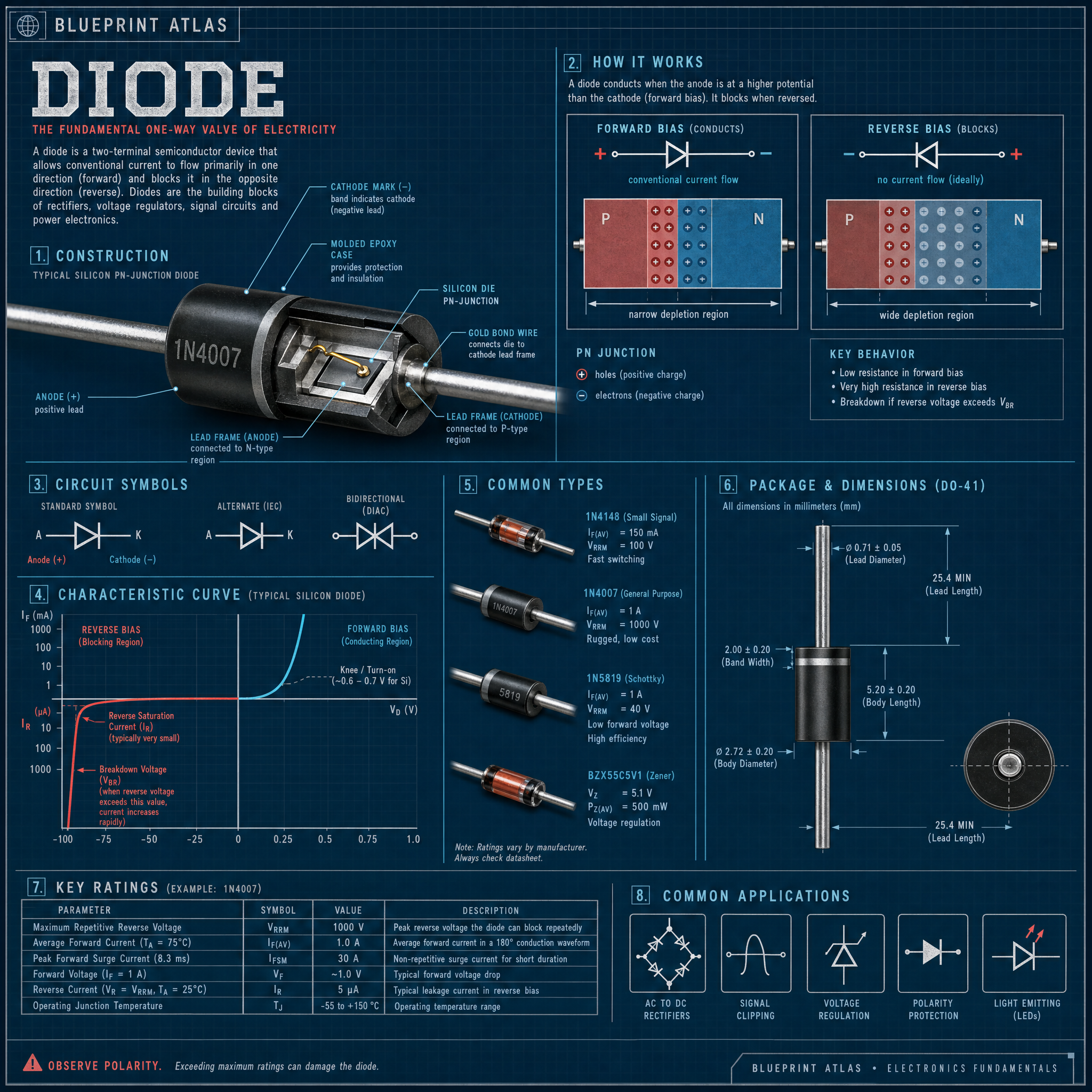
Diode
A PN junction that conducts current in one direction and blocks it in the other. Four diodes in a bridge turn AC into DC; Schottky diodes switch fast enough for SMPS; Zeners clamp voltages by deliberately operating in reverse breakdown; TVS diodes shunt ESD spikes to ground. The fundamental non-linear element of solid-state electronics.
Sheet 006
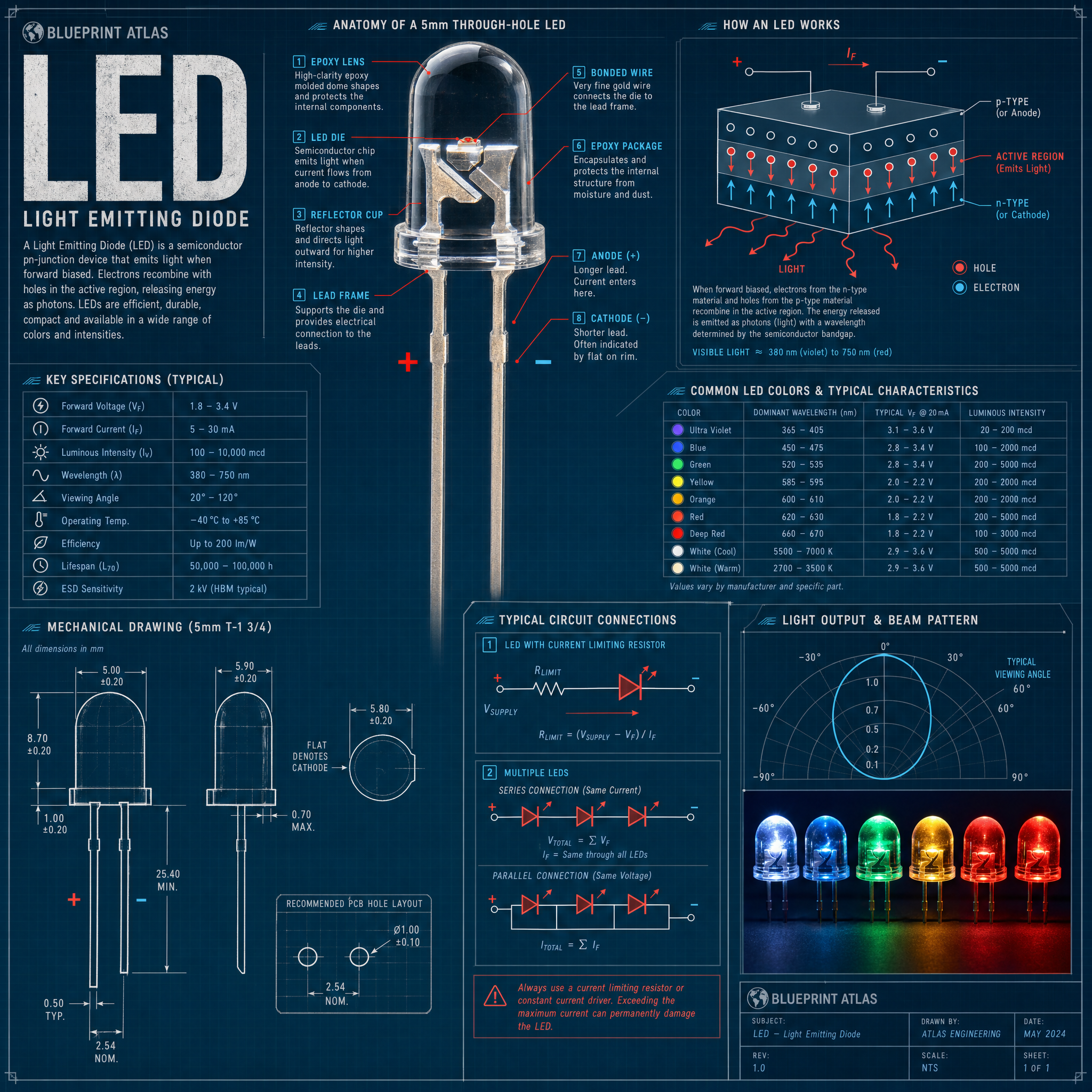
LED
A specialised diode whose PN junction emits photons whenever an electron drops into a hole — wavelength is set by the bandgap of the semiconductor. Shuji Nakamura’s blue InGaN LED in 1993 unlocked white light via phosphor conversion and earned the 2014 Nobel Prize, replacing incandescent and fluorescent lighting almost everywhere on Earth.
Sheet 007
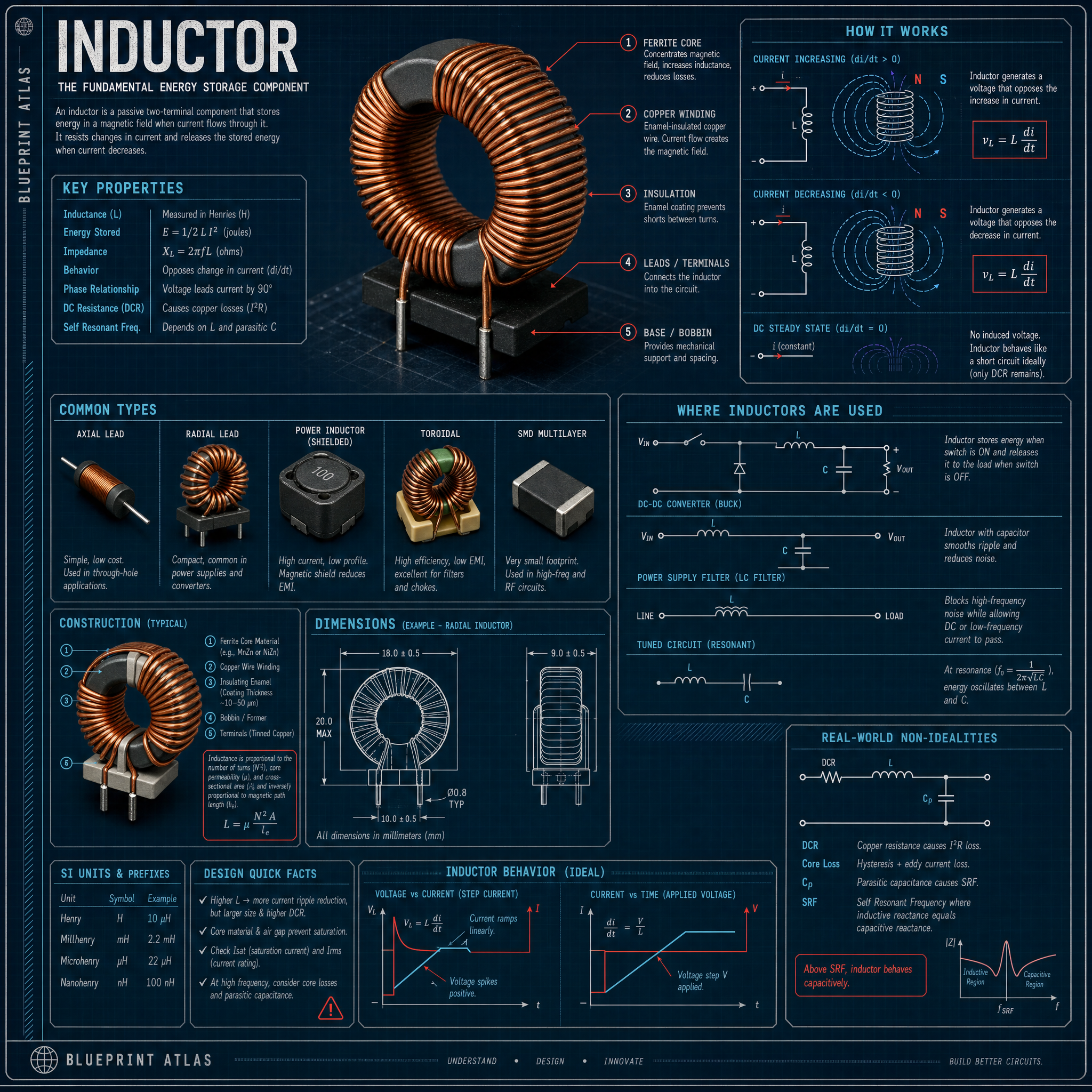
Inductor
A coil of wire that opposes any change in current by storing energy in its magnetic field. With capacitors and resistors it forms LC tanks, filters and resonators; in switch-mode supplies the inductor is the energy bucket that hands charge from input to output every cycle. Closing a current through one is the only way to make a magnetic field on demand.
Sheet 008
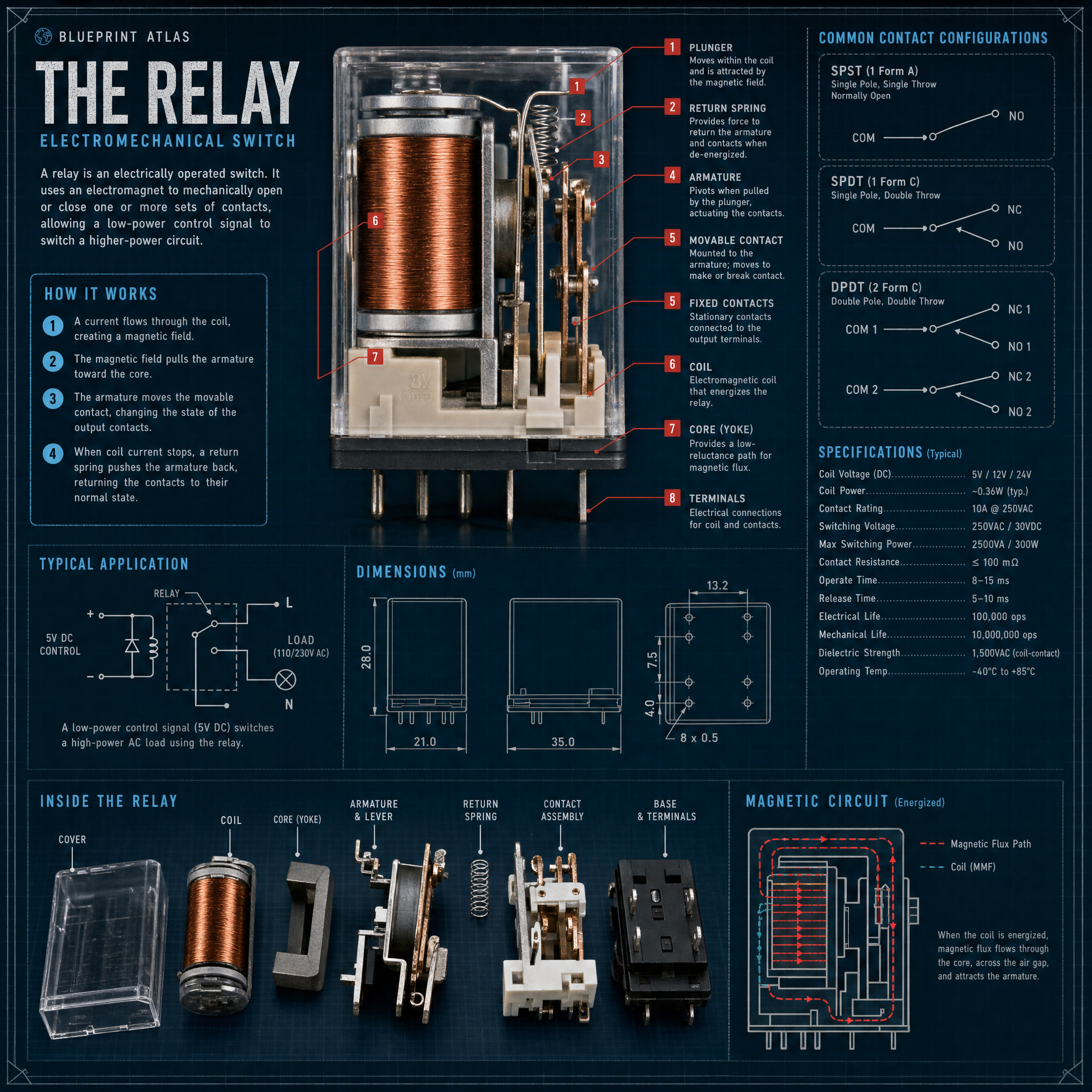
Relay
A coil pulls an iron armature when energised, snapping a set of contacts open or closed; a low-power signal switches a high-power circuit while keeping the two galvanically isolated. Joseph Henry built the first one in 1835 to drive long telegraph lines, and the device that made the early telegraph practical still lives inside cars, fridges and industrial PLCs today.
Sheet 009
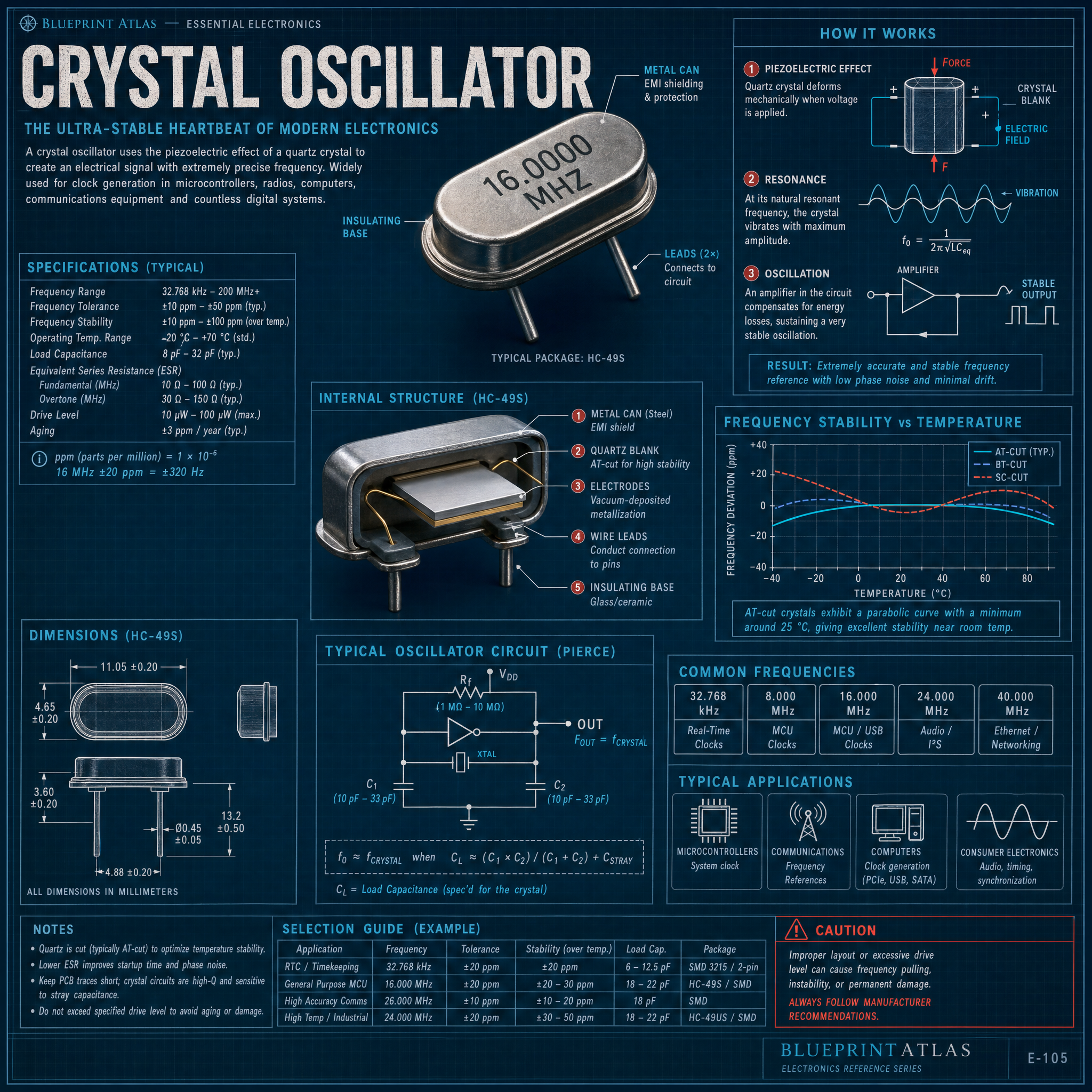
Crystal Oscillator
A thin sliver of quartz cut along a precise crystal axis vibrates at an extraordinarily stable mechanical frequency when an oscillating voltage is applied. Couple it to a feedback amplifier and the result is a clock that drifts a few seconds per month, not per minute — the heartbeat behind every microprocessor, radio, GPS receiver and wristwatch.
Sheet 010
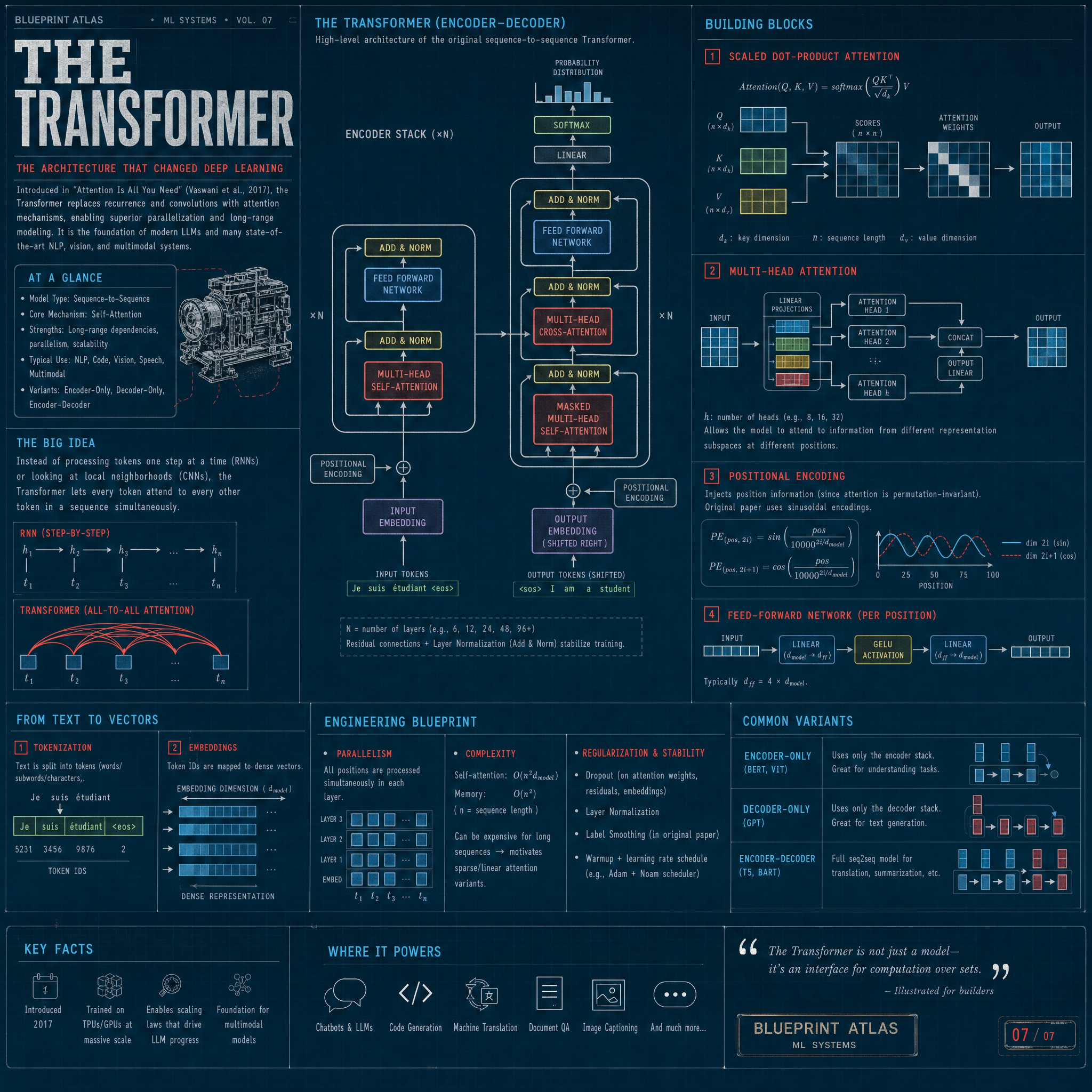
Transformer
Two coils sharing a magnetic core — current in the primary winding forges a flux that induces a voltage in the secondary, scaled by the ratio of turns. Transformers are the reason long-distance AC transmission won the War of the Currents: ten thousand volts on the line, then 230 V at the wall. Without them, the modern grid would be impossible.