Revised 2026
Sheet 001
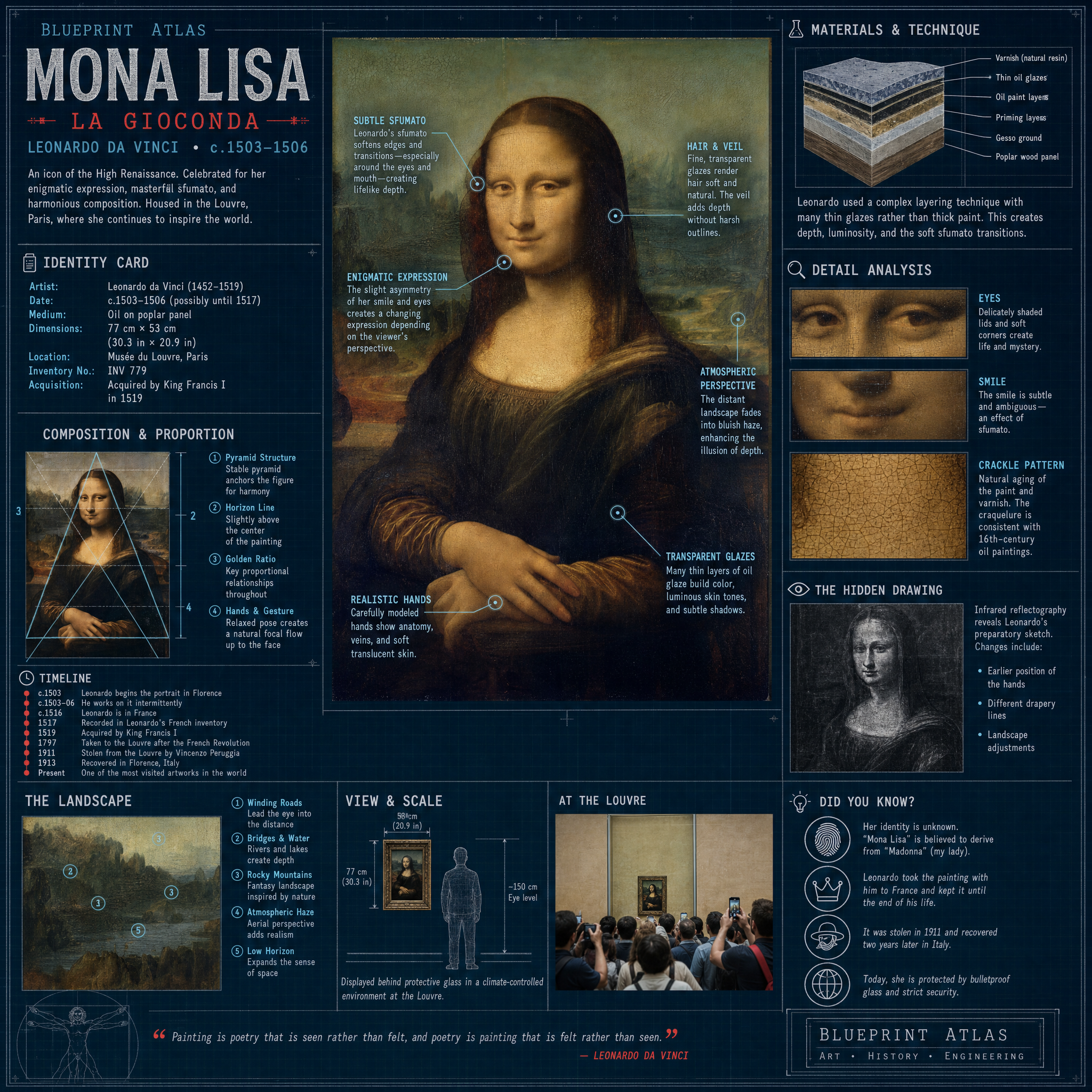
Mona Lisa
Leonardo’s portrait of Lisa Gherardini, built in layered sfumato — dozens of translucent glazes that dissolve outlines into atmosphere. The enigmatic expression emerges from asymmetric treatment of the eyes and mouth, while an imagined aerial-perspective landscape recedes behind her in cool, desaturated blues.
Sheet 002
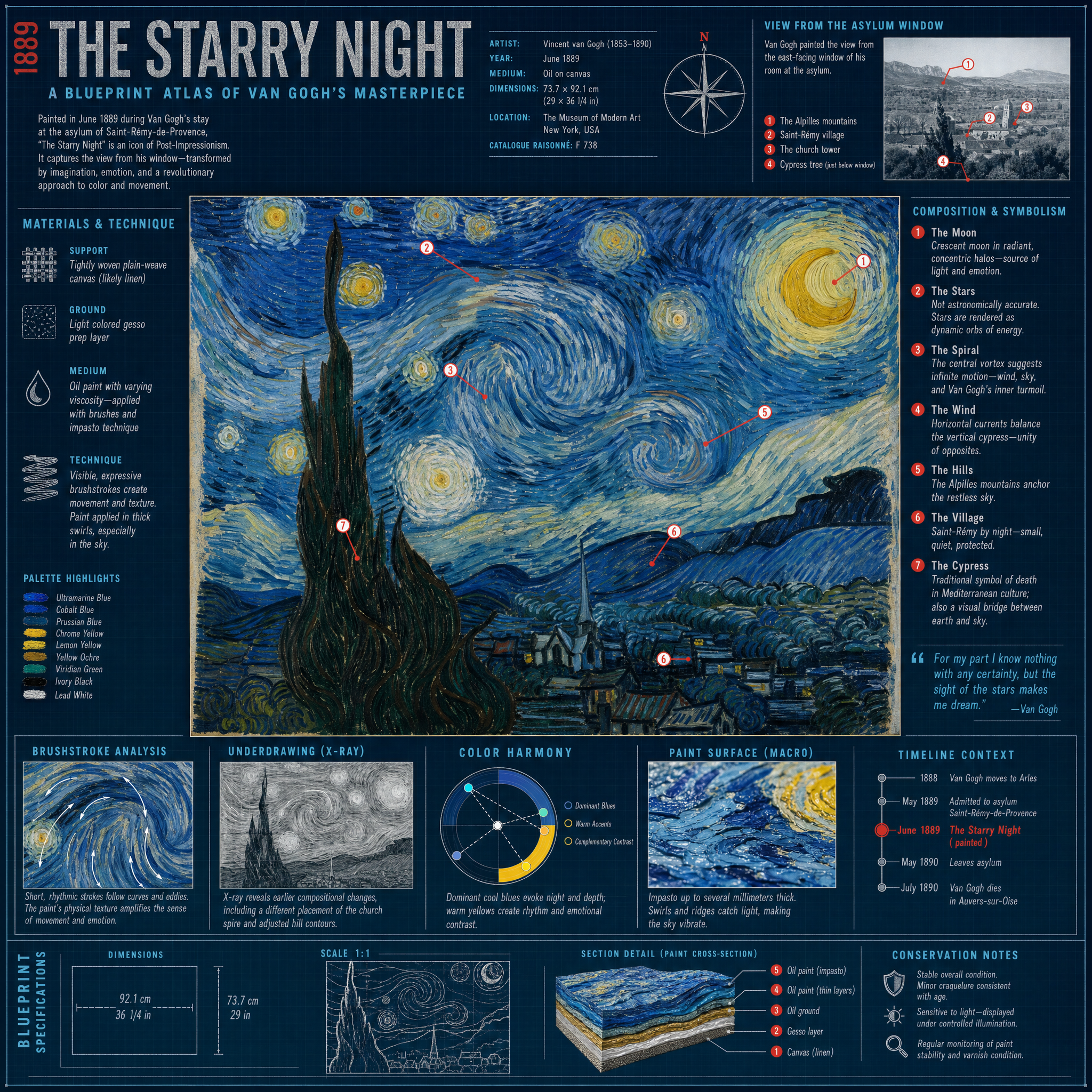
The Starry Night
Painted from memory at an asylum in Saint-Rémy-de-Provence, the sky churns in impasto whorls that physicists have since matched to the statistics of turbulent flow. A quiet village and a flame-like cypress anchor the composition, while Venus burns next to a crescent moon.
Sheet 003
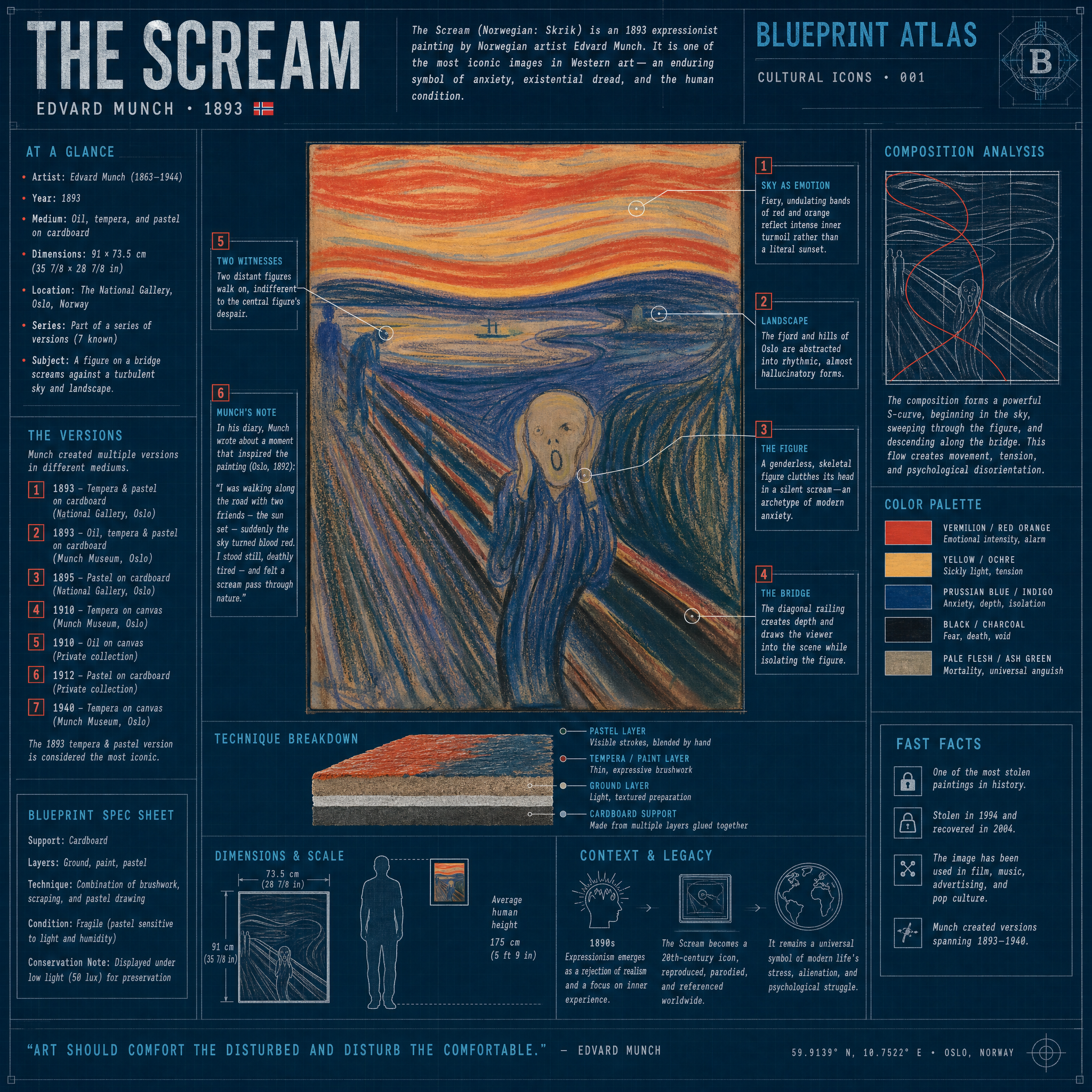
The Scream
A hairless figure clutches its skull on a bridge while the sky writhes in blood-red bands — colours some scholars link to the 1883 Krakatoa sunsets Munch witnessed. The vanishing point slams diagonally past the figure, isolating it as the wavy contours of fjord and sky keep vibrating outward.
Sheet 004
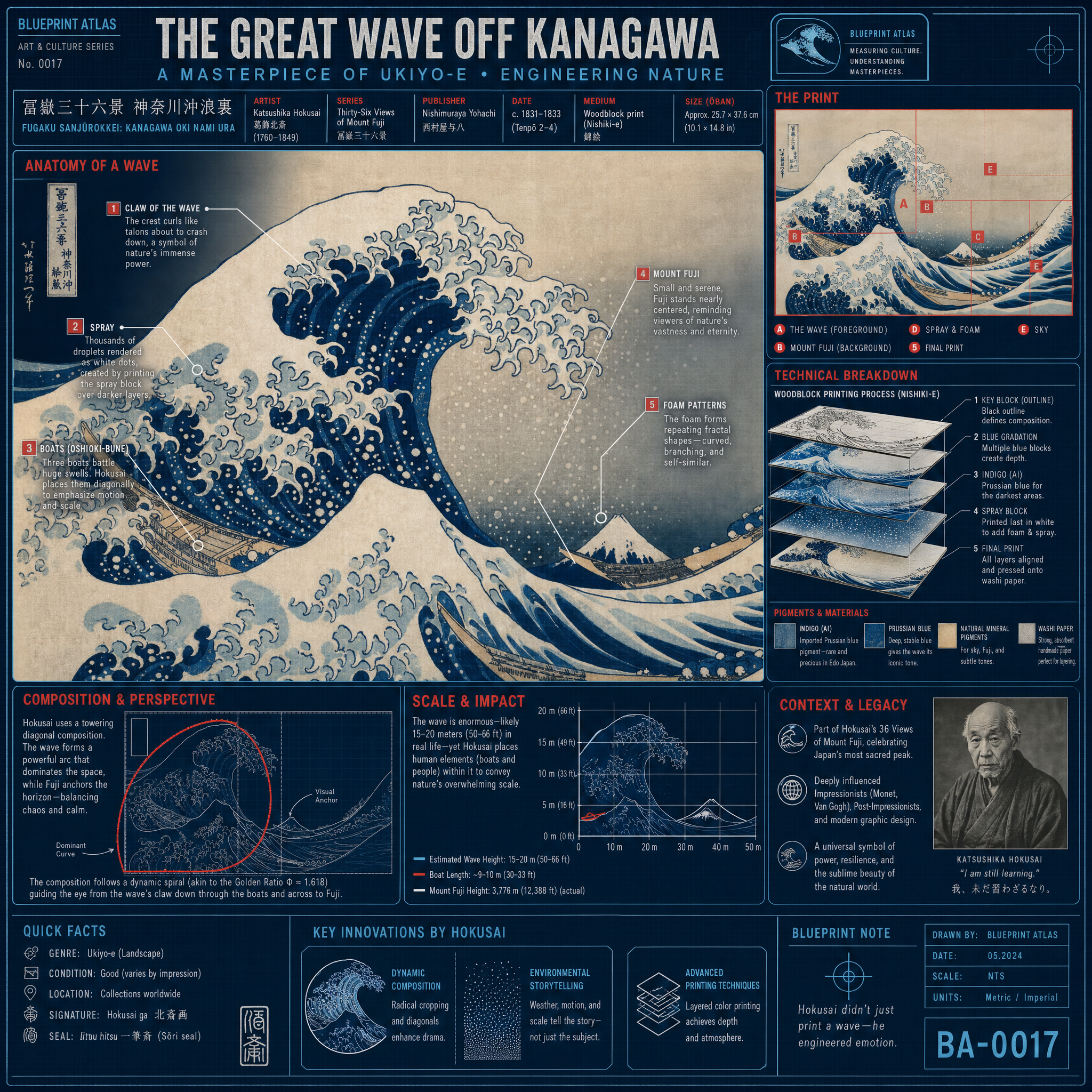
The Great Wave off Kanagawa
A multi-block polychrome print using Prussian blue imported from Europe — then a new pigment in Japan. The wave’s claws curl in near-fractal self-similarity, dwarfing three oshiokuri-bune fishing boats, with Mount Fuji a small, still triangle behind. Printed from a carved key-block plus colour blocks, pulled in the thousands.
Sheet 005
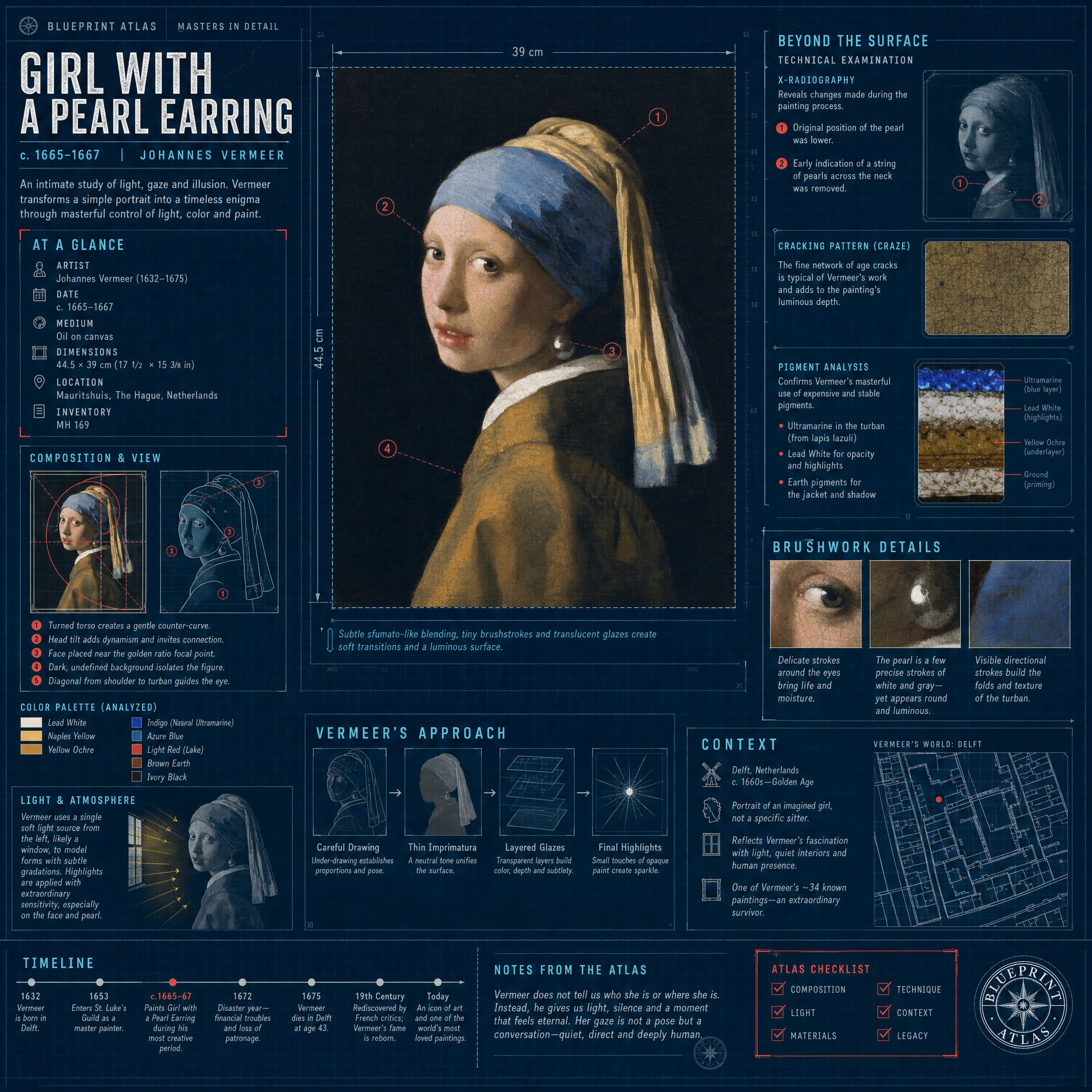
Girl with a Pearl Earring
Not a portrait but a tronie — a Dutch genre study of an imagined sitter. Vermeer models the face in soft wet-in-wet glazes and renders the pearl as just two dabs of lead-tin white on a grey base. The turban’s blue is ultramarine ground from lapis lazuli, the most expensive pigment of the age.
Sheet 006
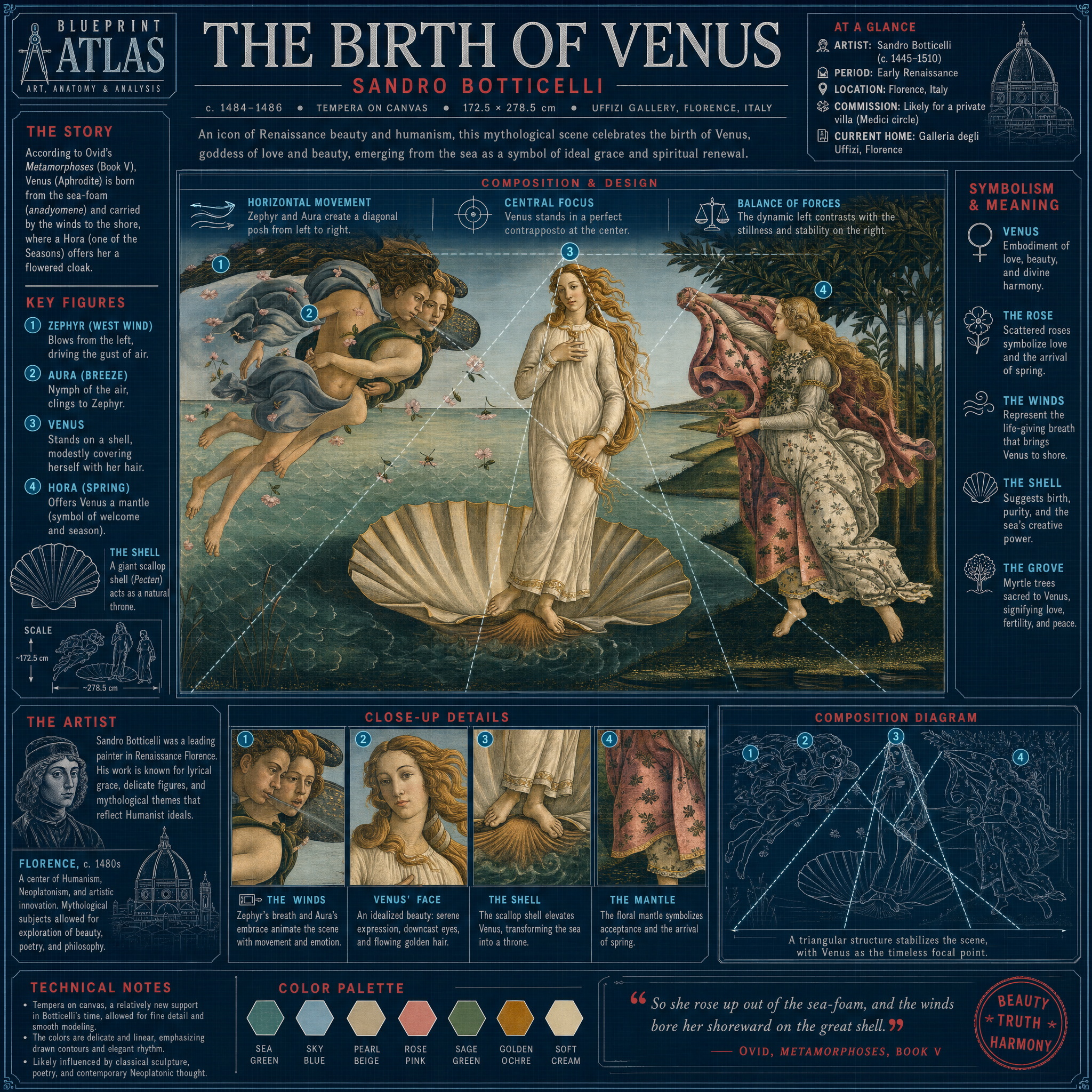
The Birth of Venus
A Neo-Platonic allegory of divine beauty arriving on the shore of Cyprus, carried by the west wind Zephyrus and received by one of the Horae. Unusually, it was painted in tempera on canvas rather than panel, and is among the earliest large-scale mythological scenes of the Italian Renaissance.
Sheet 007
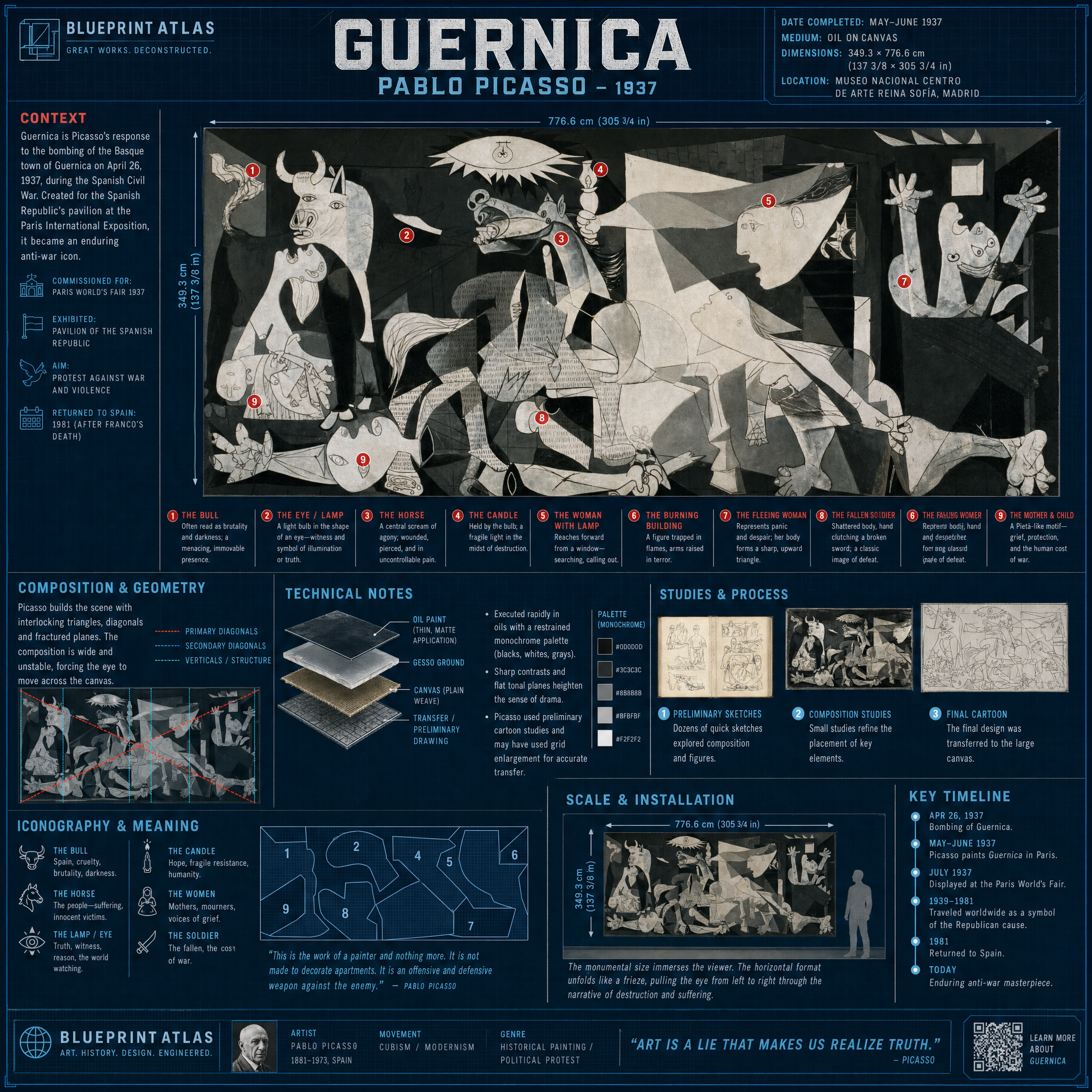
Guernica
Picasso’s response to the Nazi Condor Legion bombing of the Basque town of Guernica, painted for the 1937 Paris Exposition. The monochrome palette and newsprint-stipple textures mimic the grim, grainy reportage of the event, while cubist fragmentation shatters the bull, horse, and screaming figures into an icon of anti-war suffering.
Sheet 008
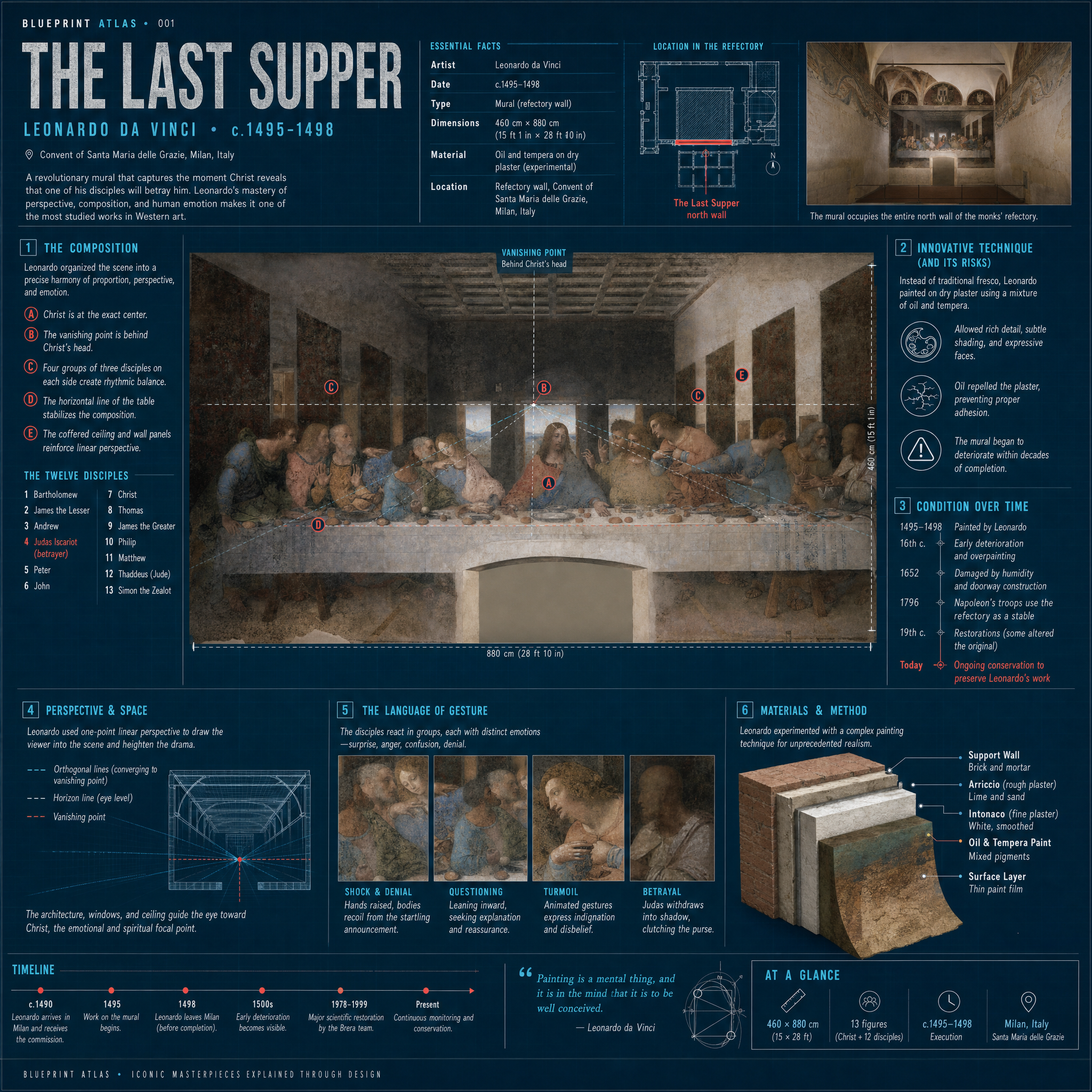
The Last Supper
Leonardo captured the instant Christ says “one of you will betray me” — the apostles recoil in four groups of three, with Christ alone at the geometric centre. Rejecting true fresco, he painted onto dry plaster for more subtle modelling, a technique that began flaking within decades and has driven five centuries of restoration.
Sheet 009
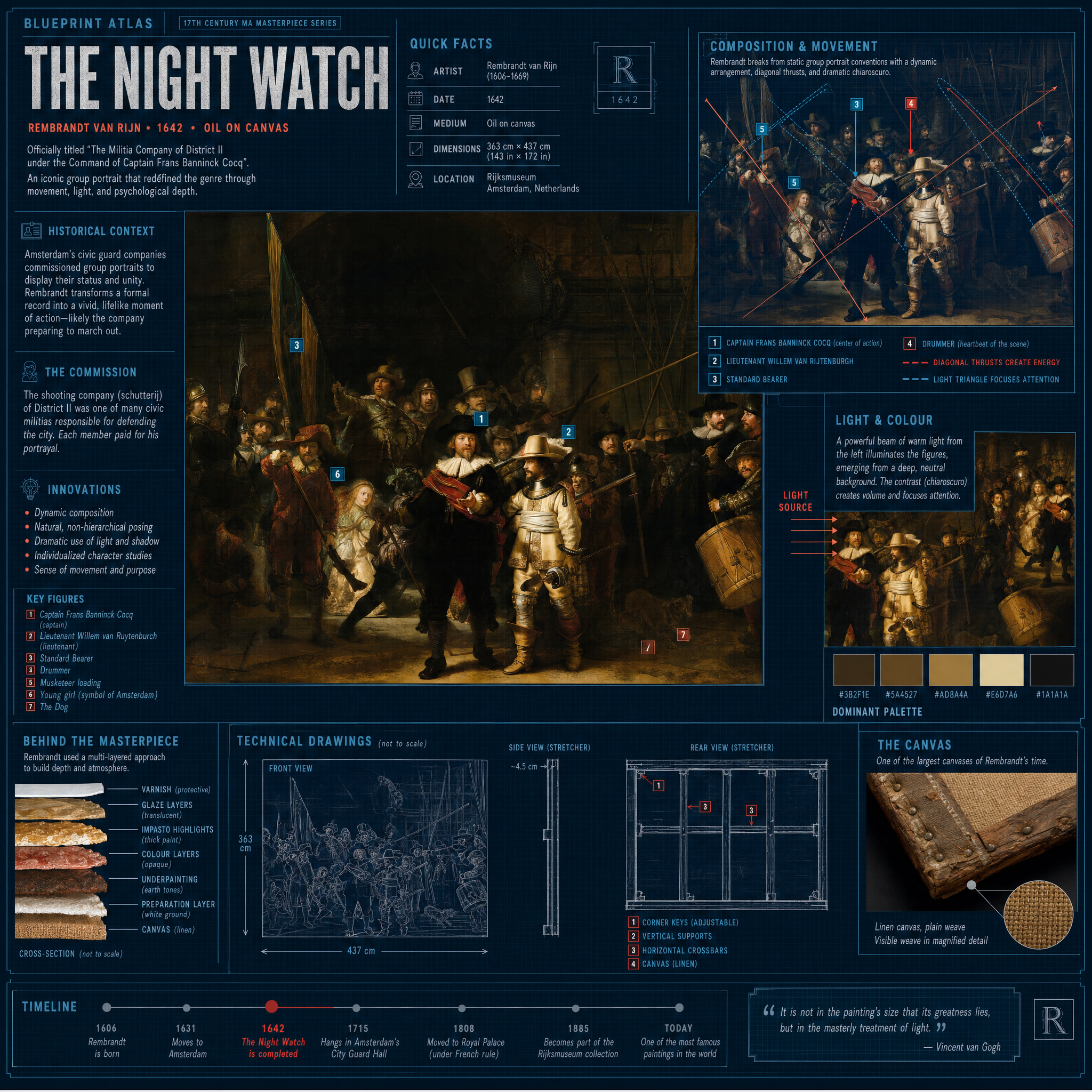
The Night Watch
A group portrait of Amsterdam militiamen rescued from the stiff “row of heads” convention by Rembrandt’s theatrical chiaroscuro and marching diagonal. The scene is not actually nocturnal — darkened varnish earned the misleading nickname. An ongoing conservation project (Operation Night Watch) images every square millimetre.
Sheet 010
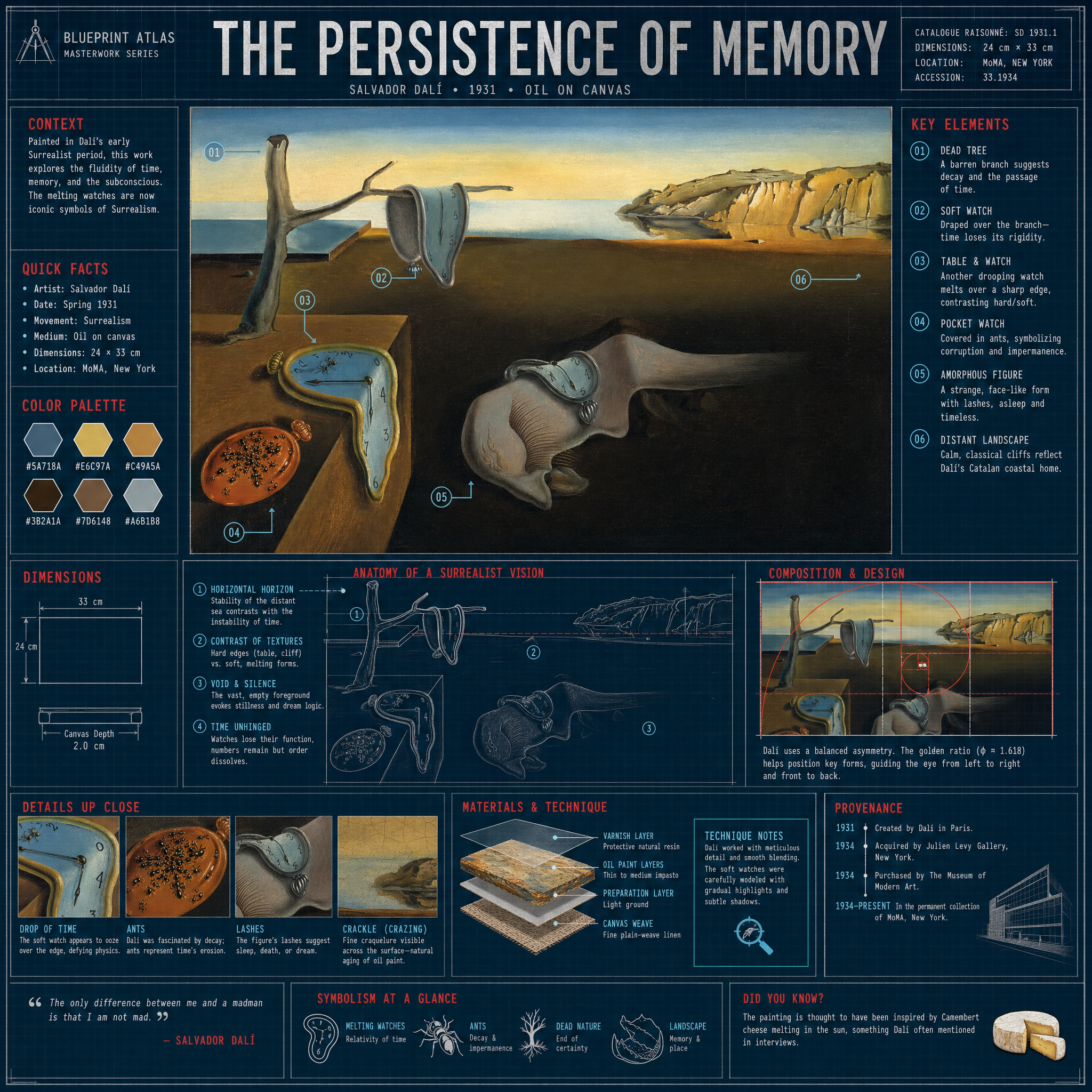
The Persistence of Memory
Dalí’s surrealist icon: three pocket watches melt over a tree branch, a plinth, and a soft anamorphic self-portrait, while a fourth is swarmed by ants on Catalan cliffs. Per Dalí, the imagery arrived while watching Camembert cheese sag on a summer evening. Painted with old-master precision in a canvas barely larger than a sheet of A4.