Revised 2026
Sheet 001
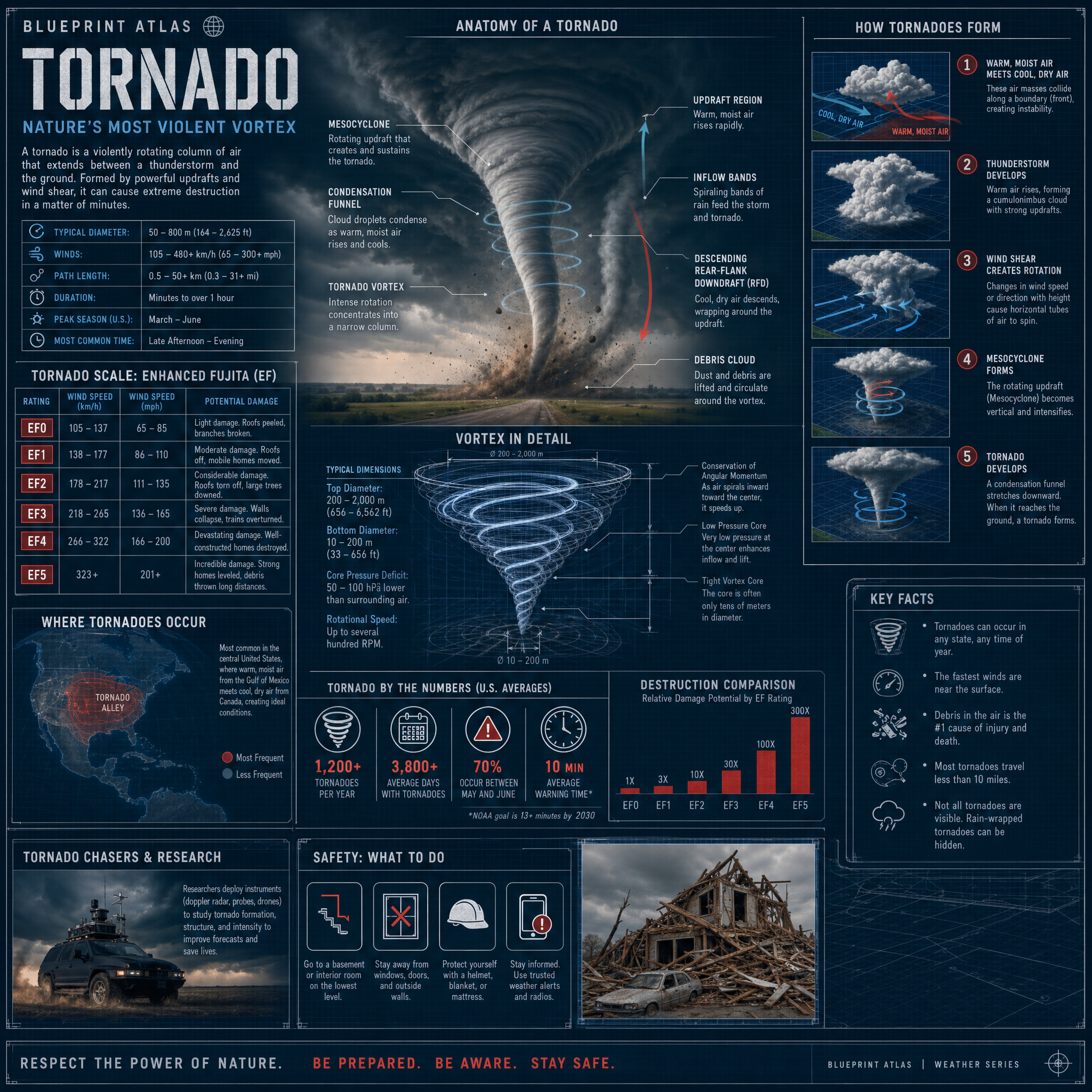
Tornado
A violently rotating column of air connecting a thunderstorm base to the ground. Warm humid air rising into a mesocyclone tightens by conservation of angular momentum, producing pressure drops large enough to lift vehicles and level framed houses.
Sheet 002
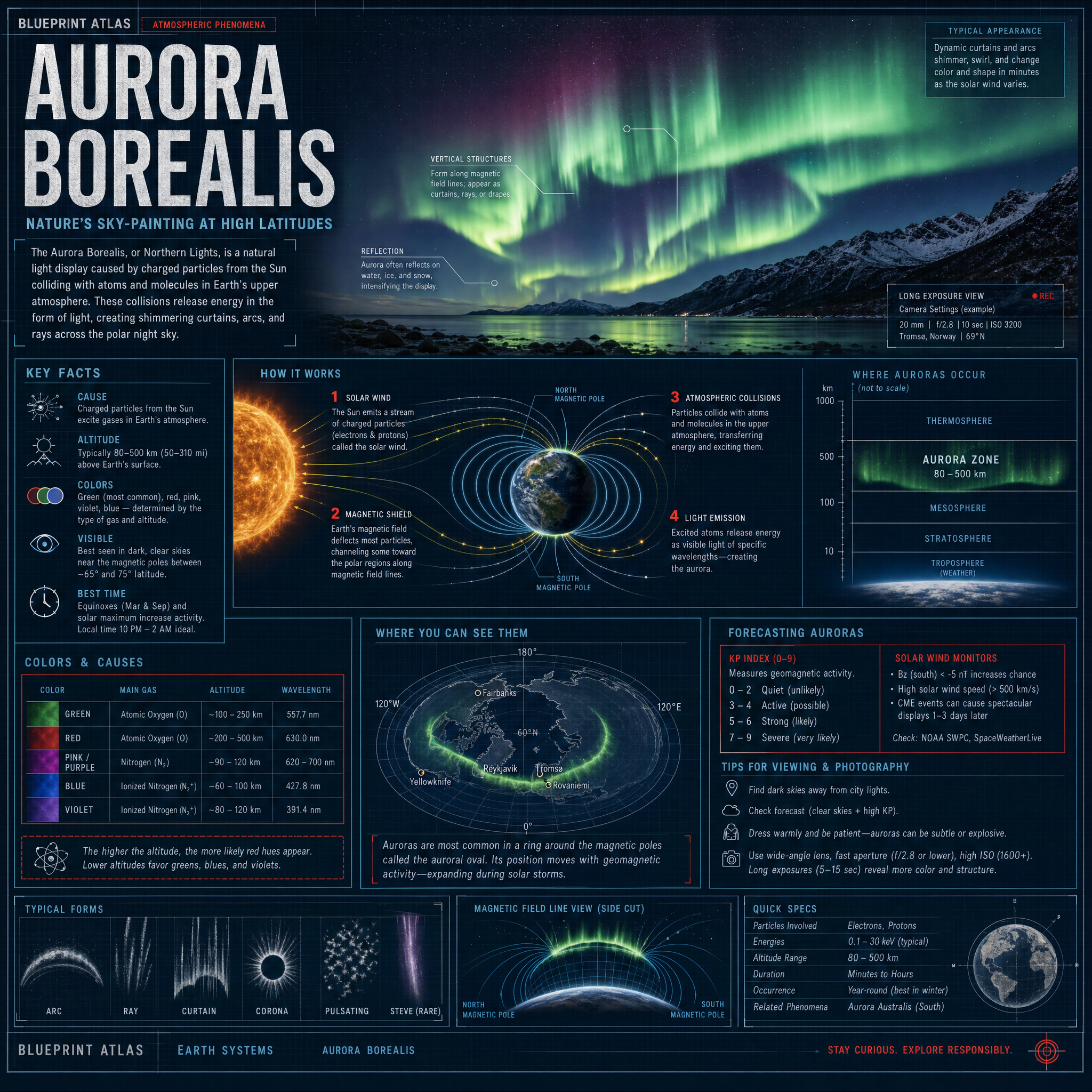
Aurora Borealis
Charged particles from the Sun funnel along Earth’s magnetic field lines into the polar ionosphere, exciting oxygen and nitrogen atoms. The glow happens on the night side of the magnetotail — a reconnection event pumped into a 20 – 25° auroral oval around each magnetic pole.
Sheet 003
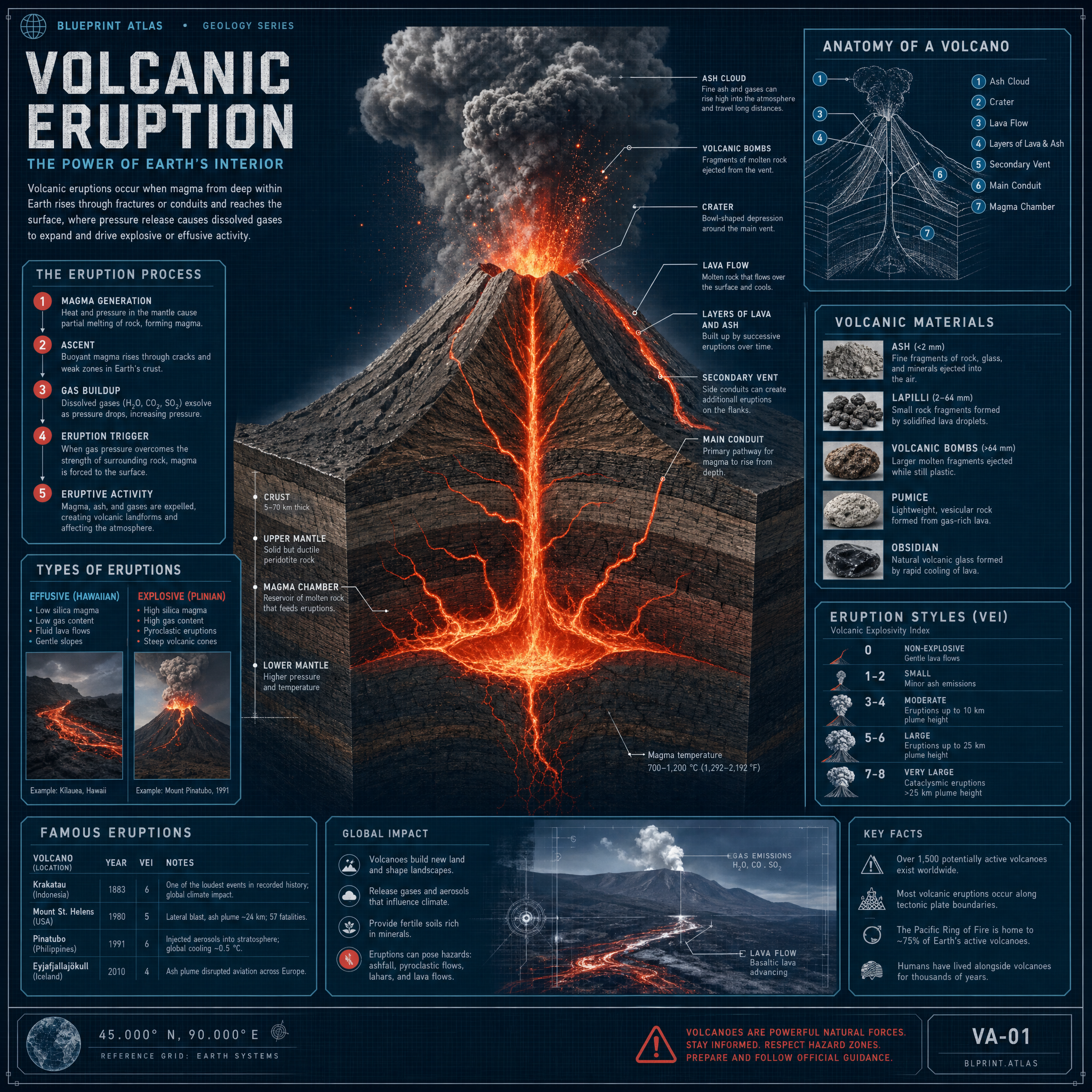
Volcanic Eruption
Molten rock, gas, and ash rise through a conduit when buoyancy and dissolved volatiles overcome overburden pressure. Silica-rich magmas trap gas and erupt explosively; low-silica basalts flow. A single VEI 7 eruption can inject enough sulphate aerosol to cool the planet for years.
Sheet 004
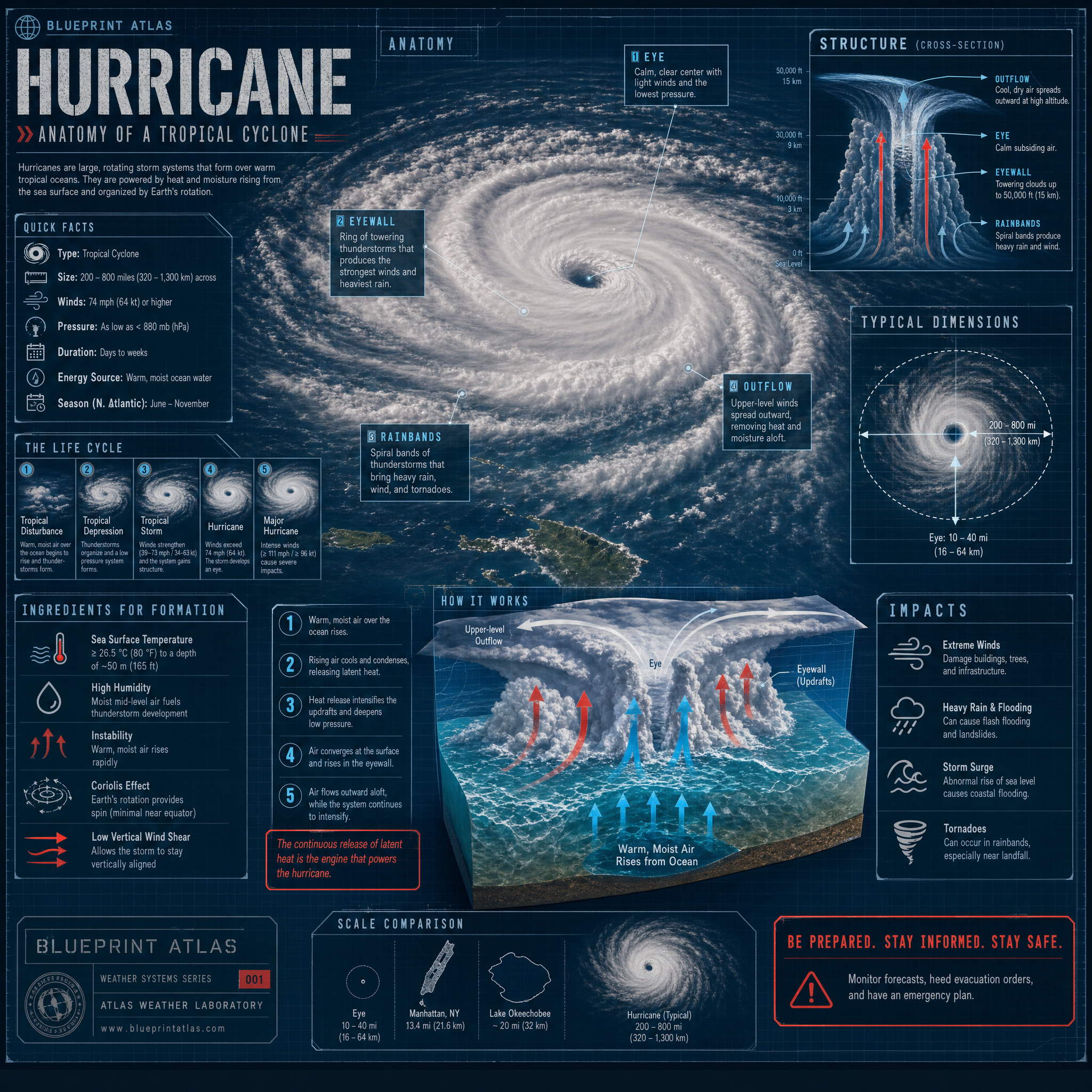
Hurricane
A warm-core rotating storm fed by latent heat from evaporating tropical ocean. Coriolis force curls inflowing air into a spiral, with the eyewall releasing energy equivalent to roughly 200 times the world’s electrical generation while it lasts.
Sheet 005
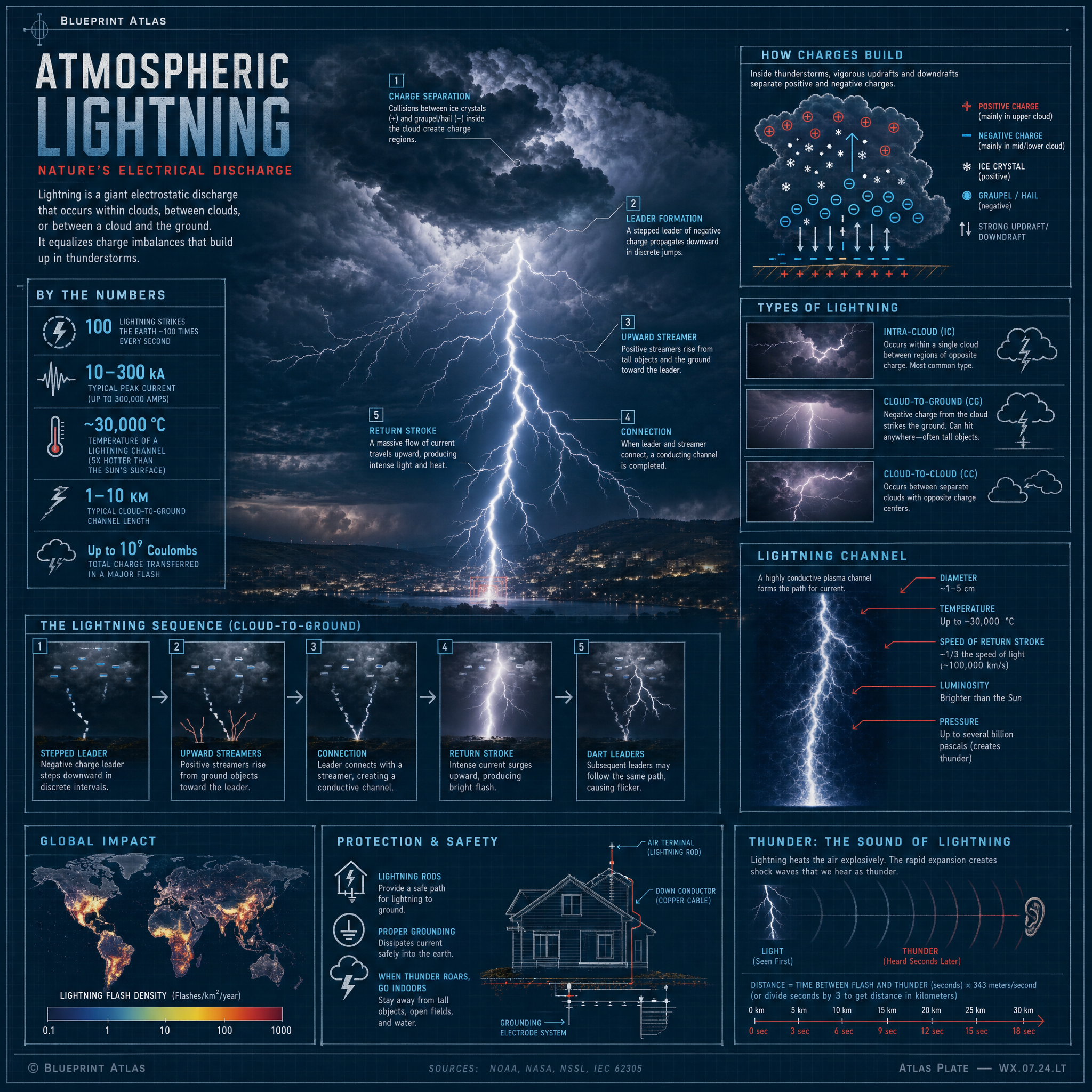
Lightning
Charge separation inside a cumulonimbus drives stepped leaders downward until they meet an upward streamer; the return stroke dumps hundreds of megajoules in microseconds. The air superheats past five times the Sun’s surface temperature, expanding supersonically as thunder.
Sheet 006
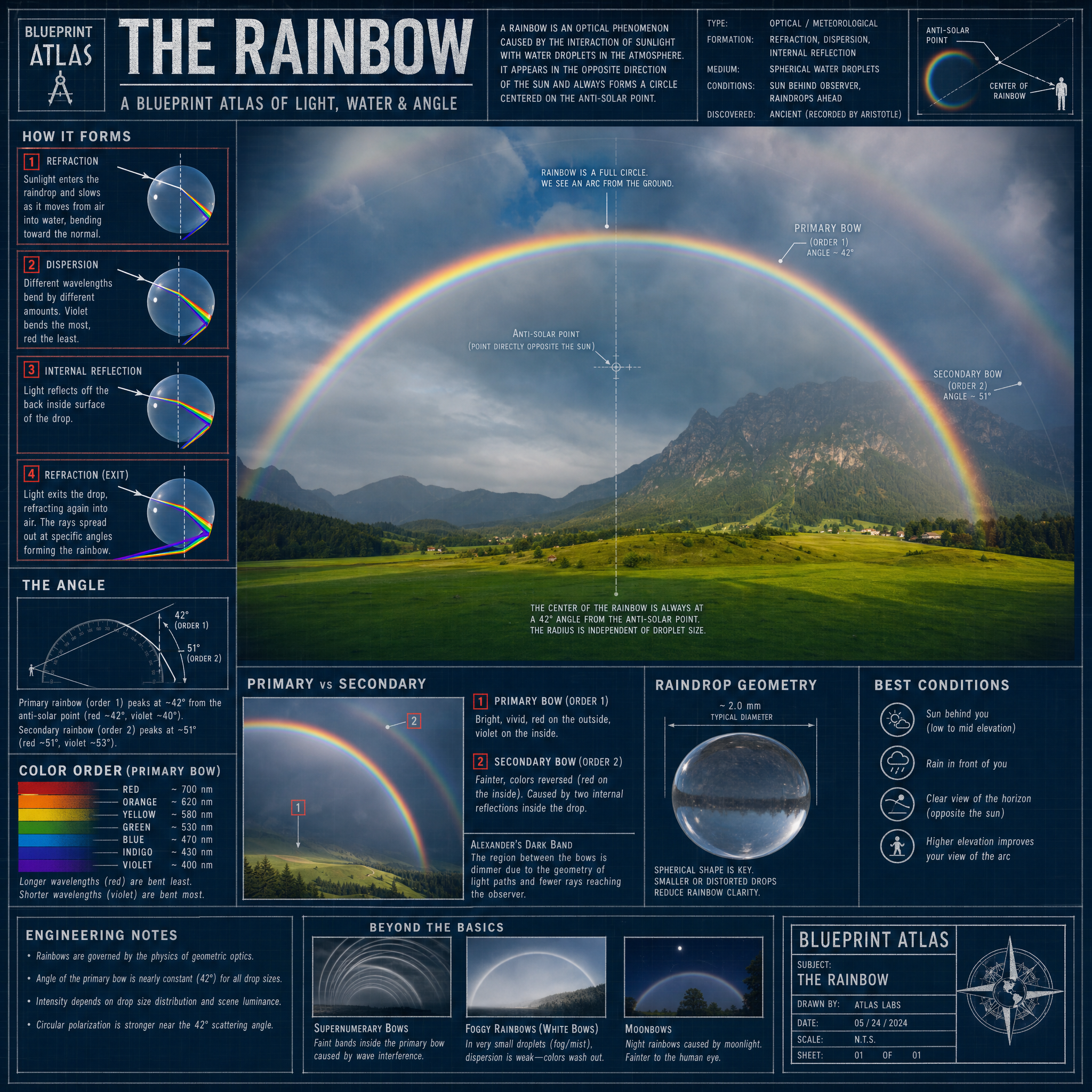
Rainbow
Sunlight refracts entering a raindrop, reflects off the back surface, and refracts again on exit — dispersion spreads the spectrum. Every drop at 42° sends red to your eye, every drop at 40° sends violet. A rainbow is therefore a map of angles, not of the sky.
Sheet 007
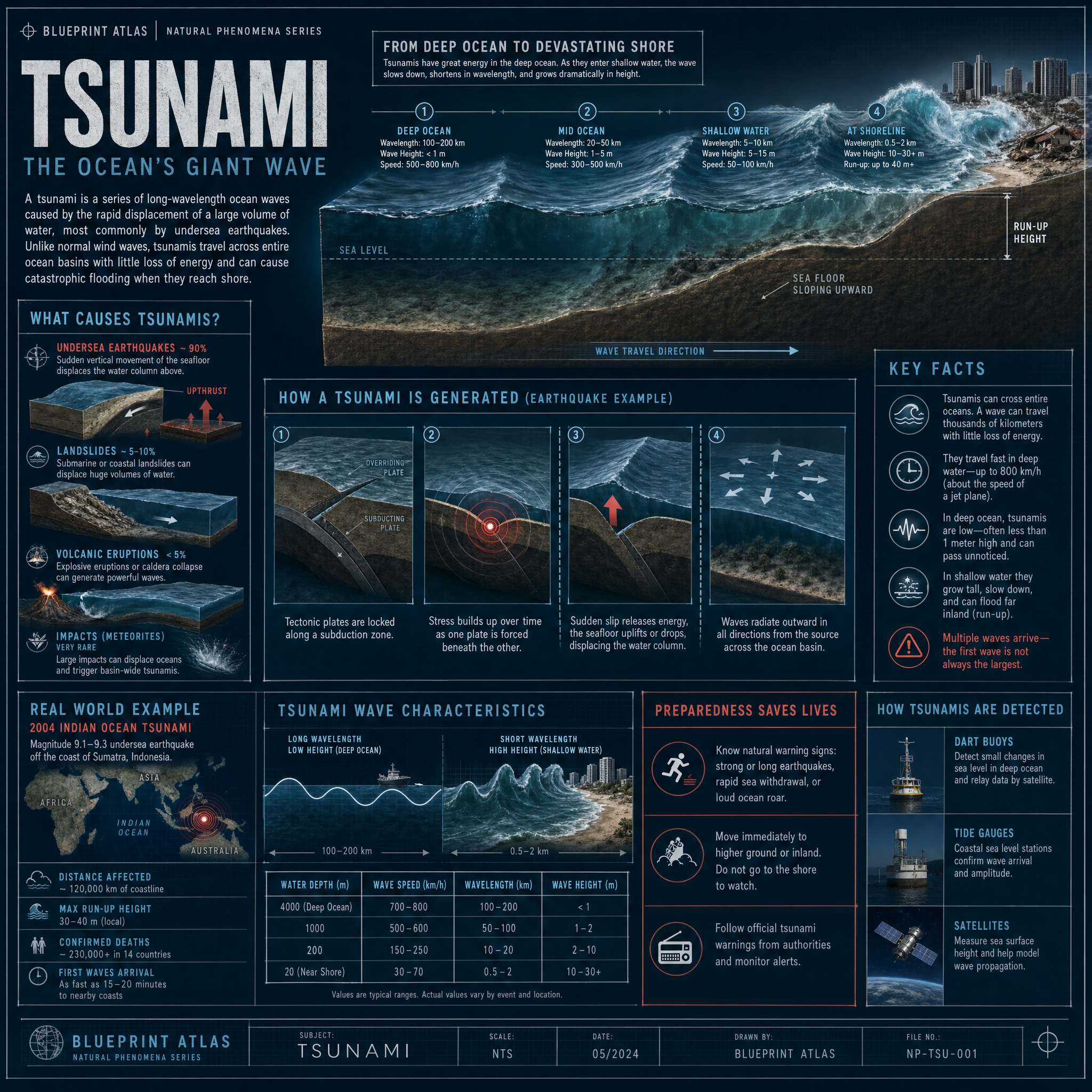
Tsunami
A seafloor displacement — usually a subduction thrust — lifts the entire water column. In the deep ocean the wave is barely a metre high but moves at jet speed; as it shoals the wavelength compresses and water piles into a devastating run-up on the coast.
Sheet 008
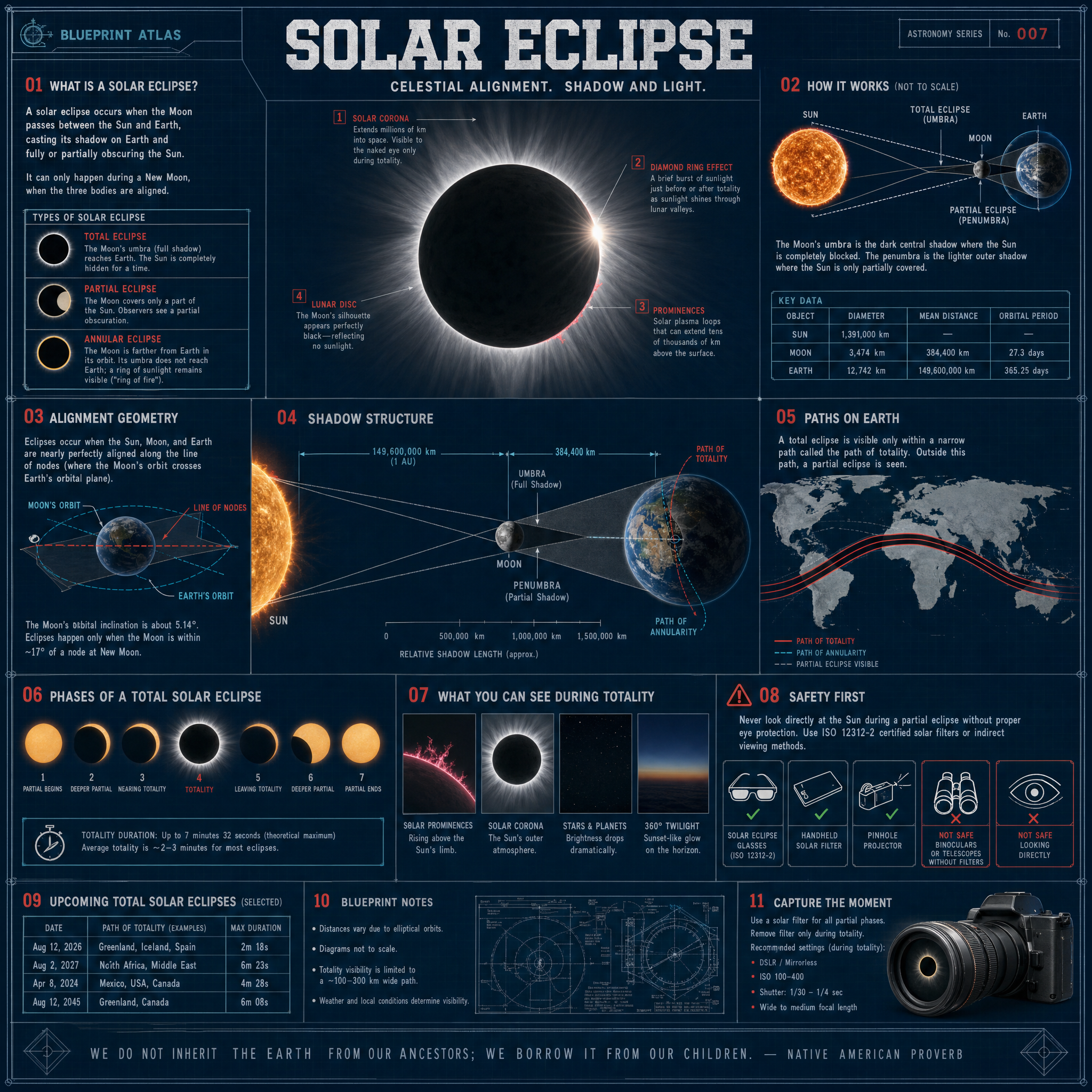
Solar Eclipse
The Moon — 400× smaller than the Sun but 400× closer — fits neatly over the solar disc during totality, revealing the corona. Eclipses recur in Saros families as the Sun-Earth-Moon geometry repeats, each family drifting slowly across latitudes over 12 centuries.
Sheet 009
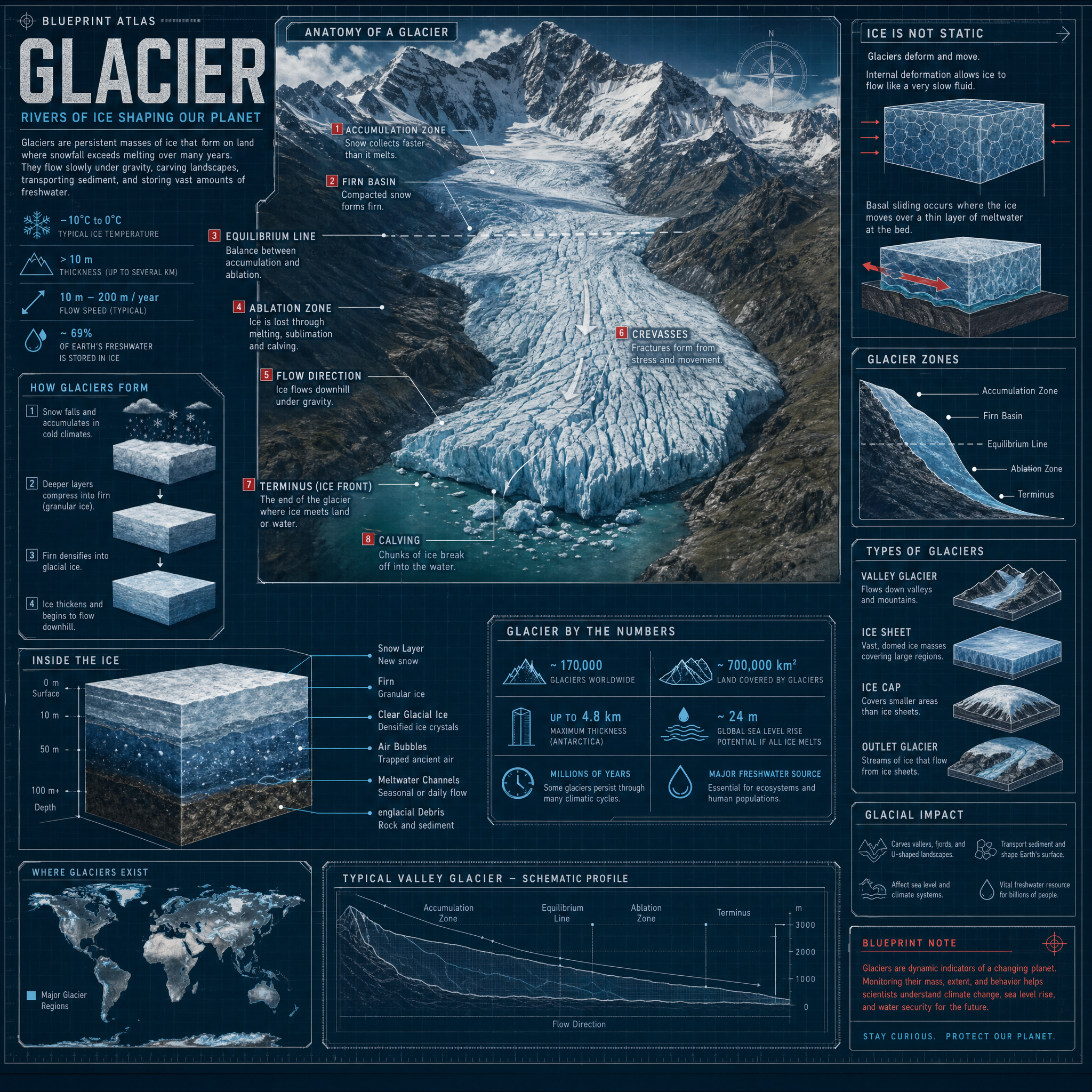
Glacier
Snow compacts to firn to ice; above the Equilibrium Line Altitude it accumulates, below it ablates. Under its own weight the ice deforms plastically and slides on meltwater, carving U-shaped valleys and dropping lateral, medial, and terminal moraines as it retreats.
Sheet 010
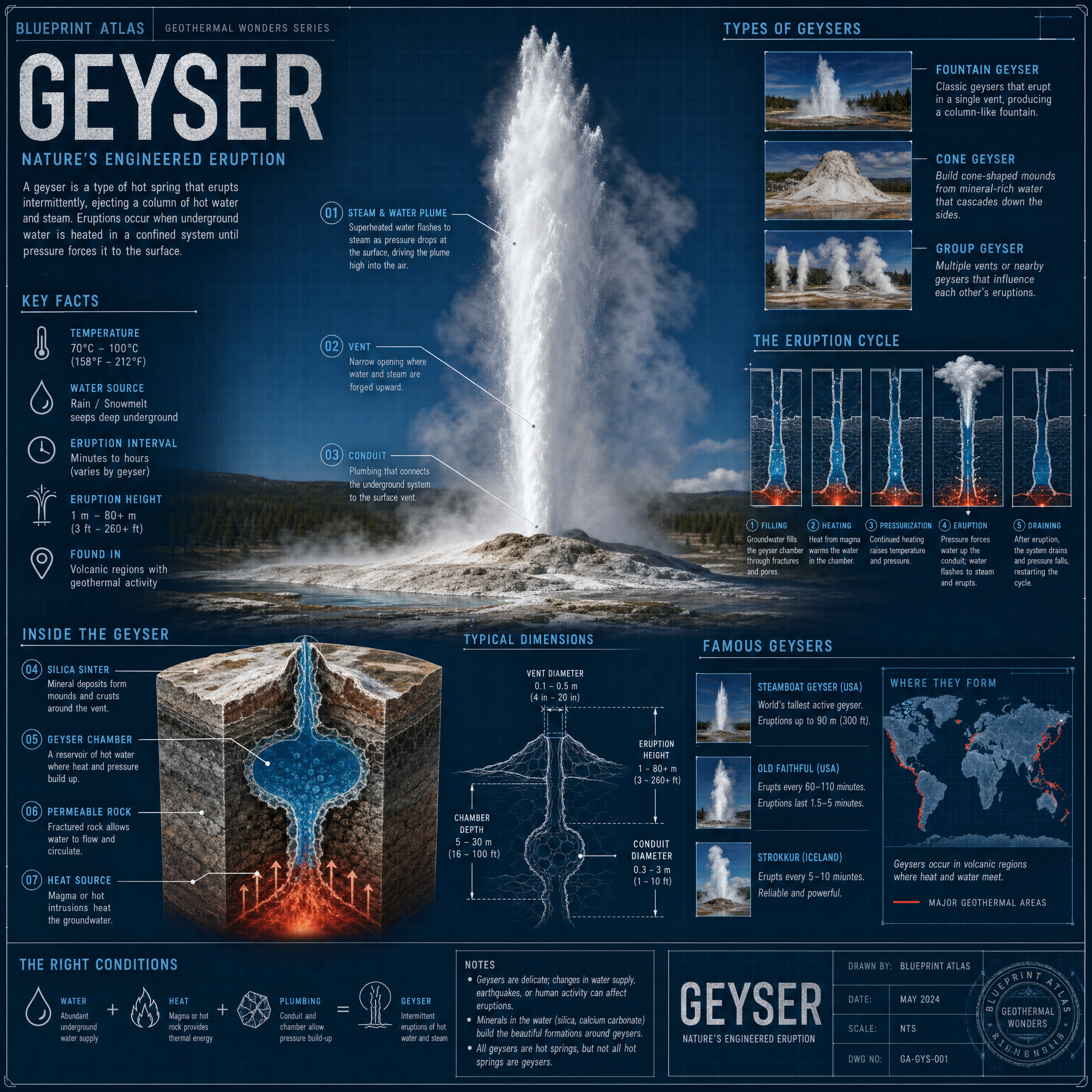
Geyser
A narrow plumbing constriction lets a deep column of groundwater superheat past boiling point at the surface. When pressure drops enough for flash-to-steam to begin, the whole column erupts — then refills, reheats, and resets. Silica precipitates build the sinter cone around the vent.