Revised 2026
Sheet 001
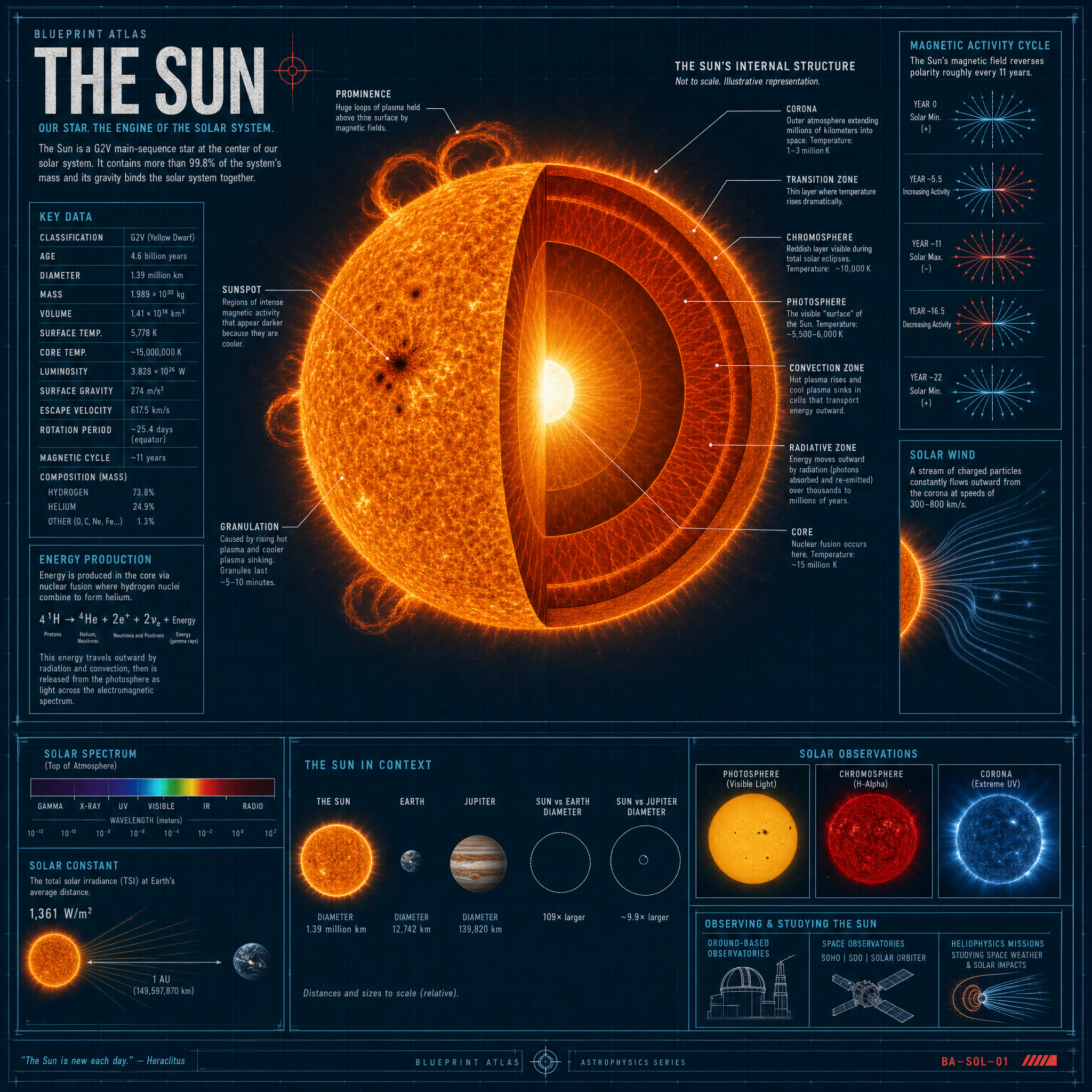
The Sun
The Sun fuses 600 million tonnes of hydrogen into helium every second. Photons born in the core spend 100,000 years diffusing out through the radiative zone before eight minutes of flight across the vacuum to us.
Sheet 002
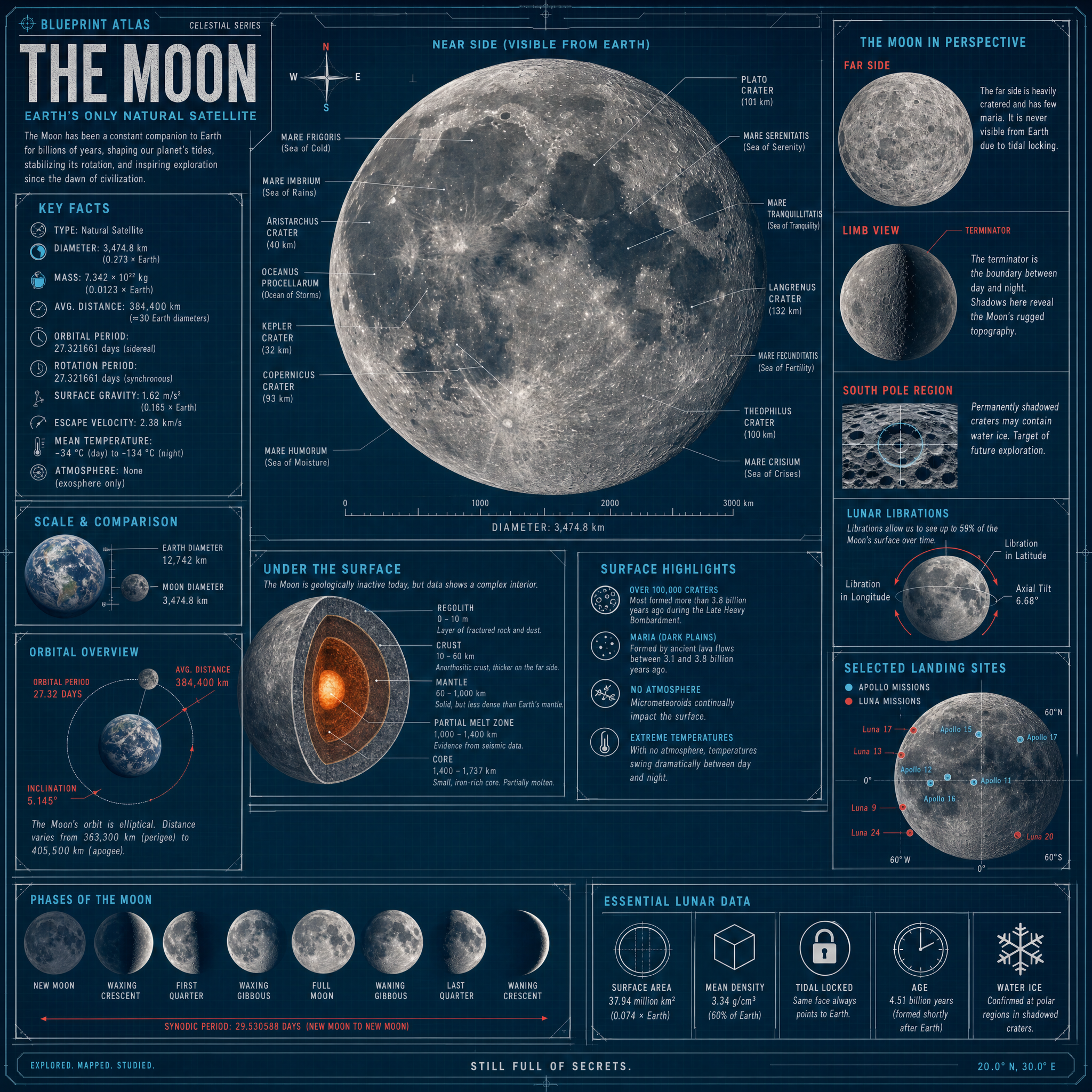
The Moon
Born 4.5 billion years ago from a Mars-sized impact with the early Earth. The Moon has been receding from us at 3.8 cm per year ever since, and it stabilises our axial tilt — and therefore our climate.
Sheet 003
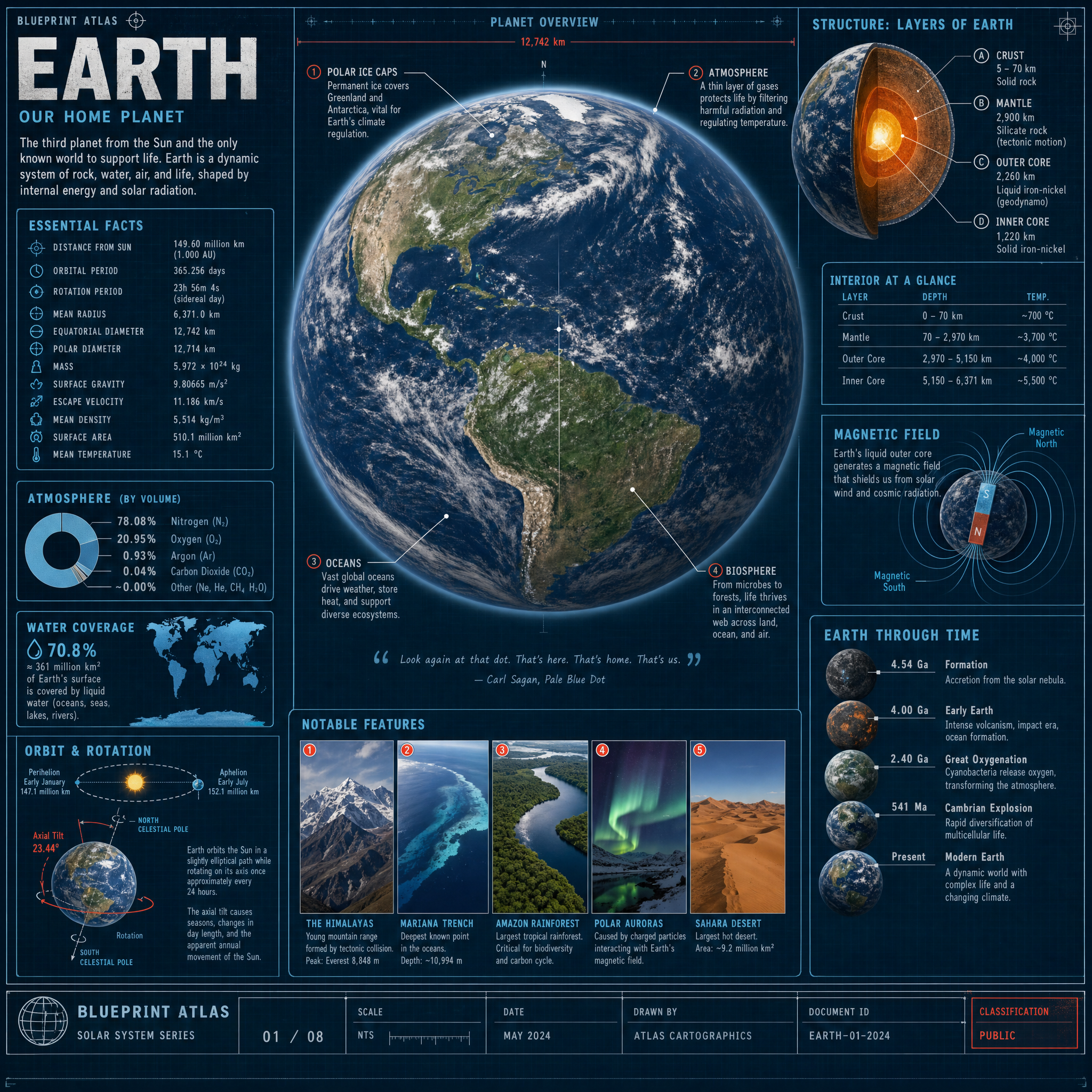
Planet Earth
A geodynamo in the liquid outer core generates a magnetic shield; plate tectonics recycle the crust; a thin biosphere uses the Sun’s energy to run chemistry nowhere else in the solar system appears to match.
Sheet 004
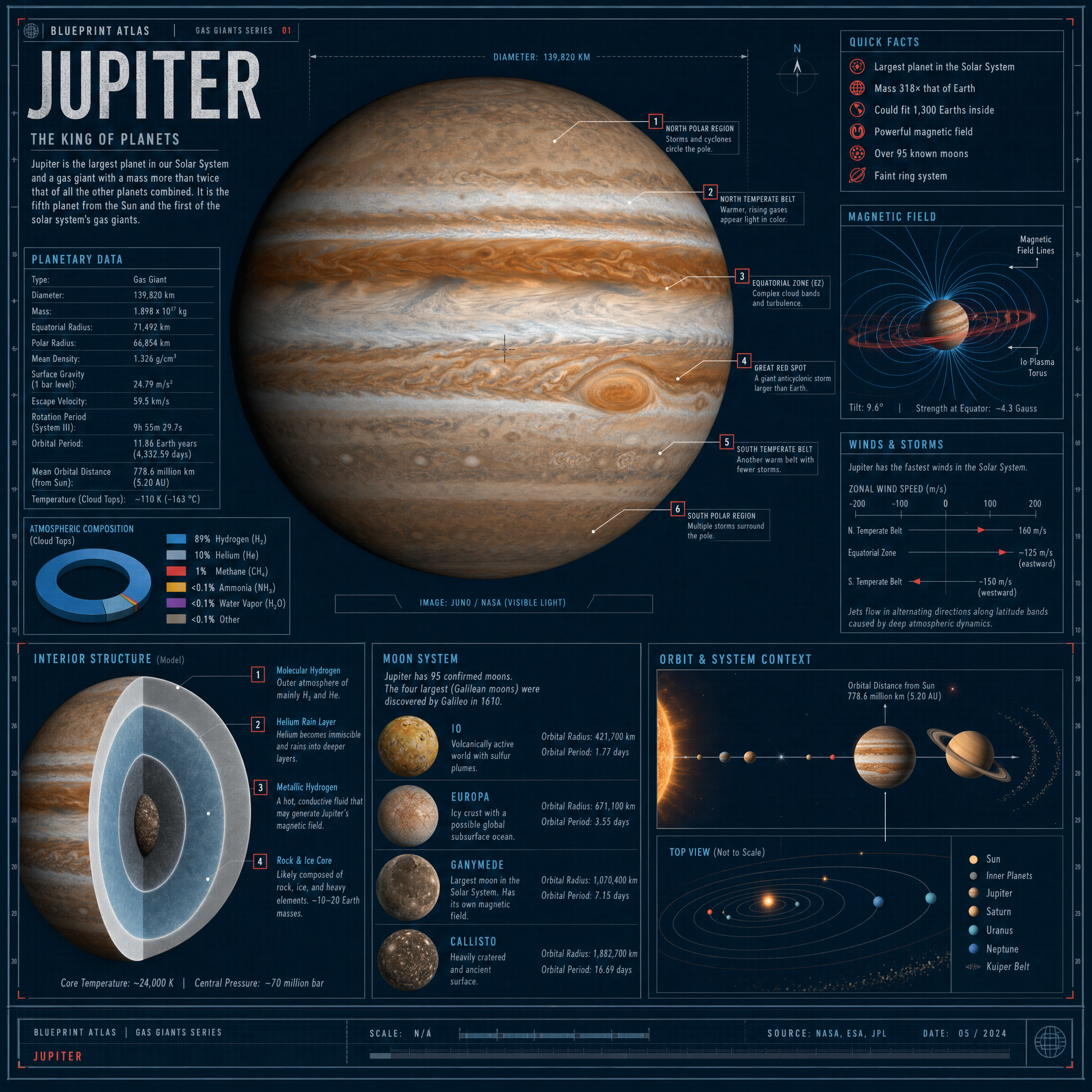
Jupiter
Jupiter is more massive than all other planets combined. Its deep atmospheric bands rotate at different speeds in alternating jets, and the Great Red Spot has been turning for at least four human centuries.
Sheet 005
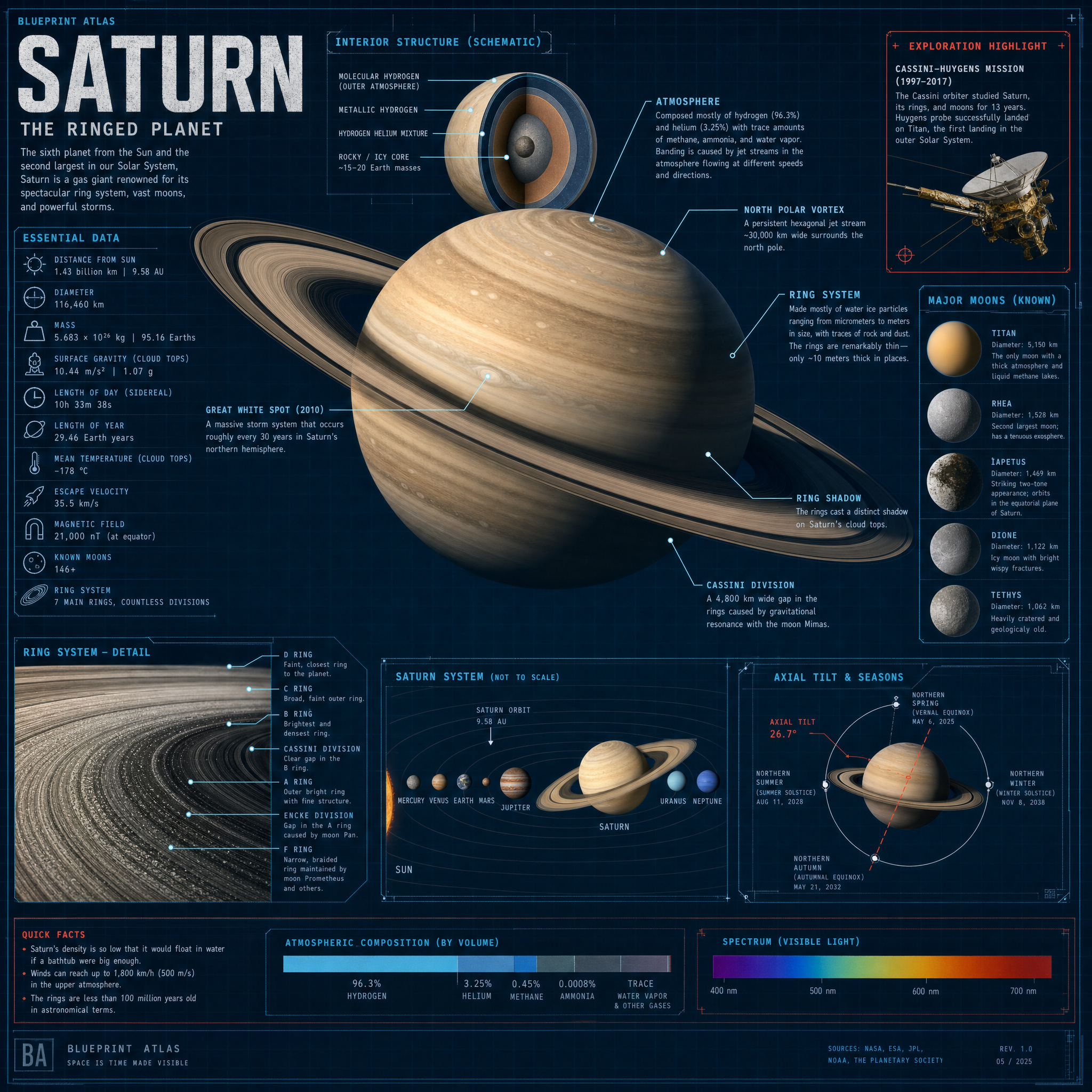
Saturn
The rings are practically all water ice — a sheet hundreds of thousands of kilometres wide and about ten metres thick. Titan is larger than Mercury and has its own dense nitrogen atmosphere and liquid-methane lakes.
Sheet 006
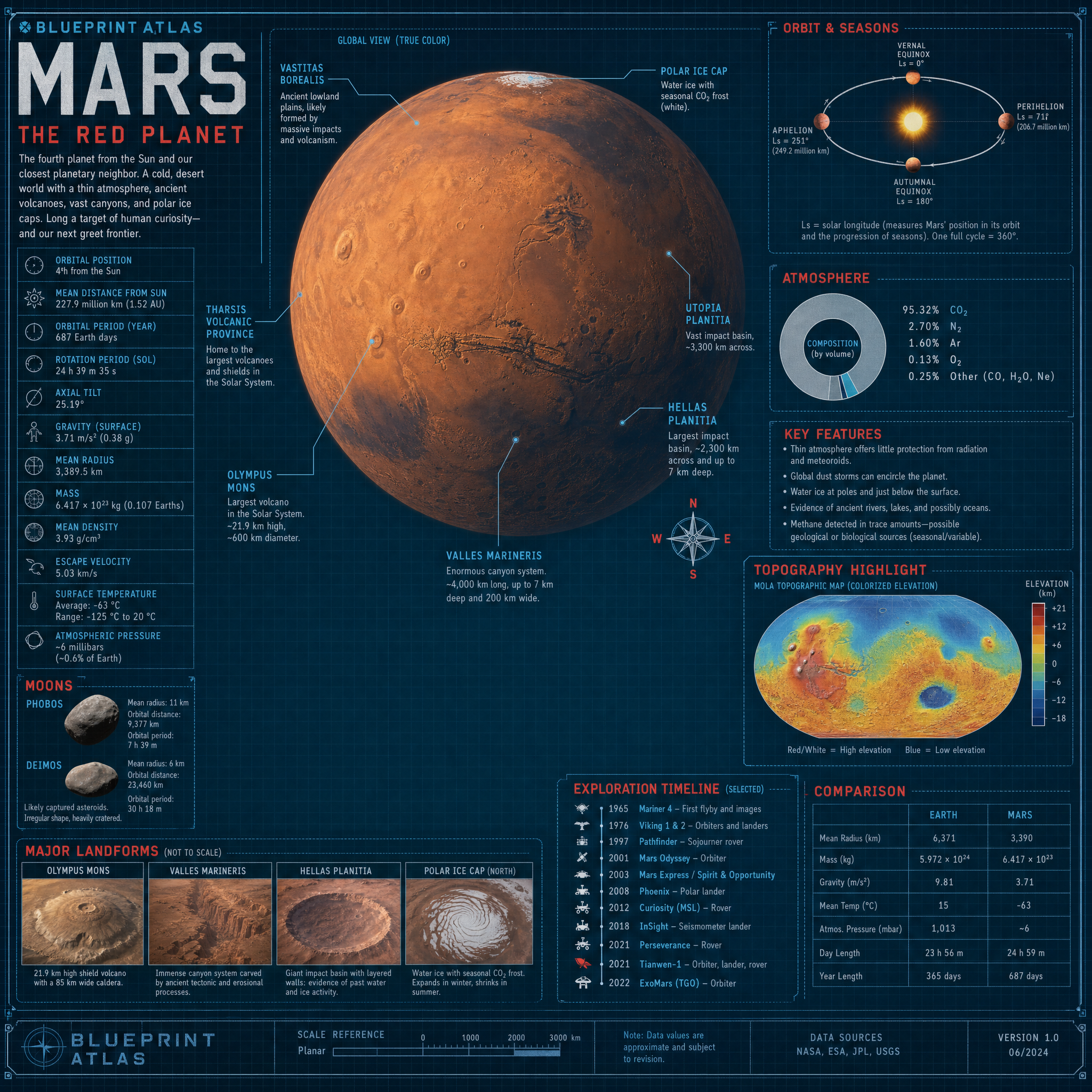
Mars
Olympus Mons is the tallest volcano in the solar system — 22 km high, the size of France. Valles Marineris cuts across a fifth of the planet. Ancient riverbeds and polar ice tell the story of a wetter Mars.
Sheet 007
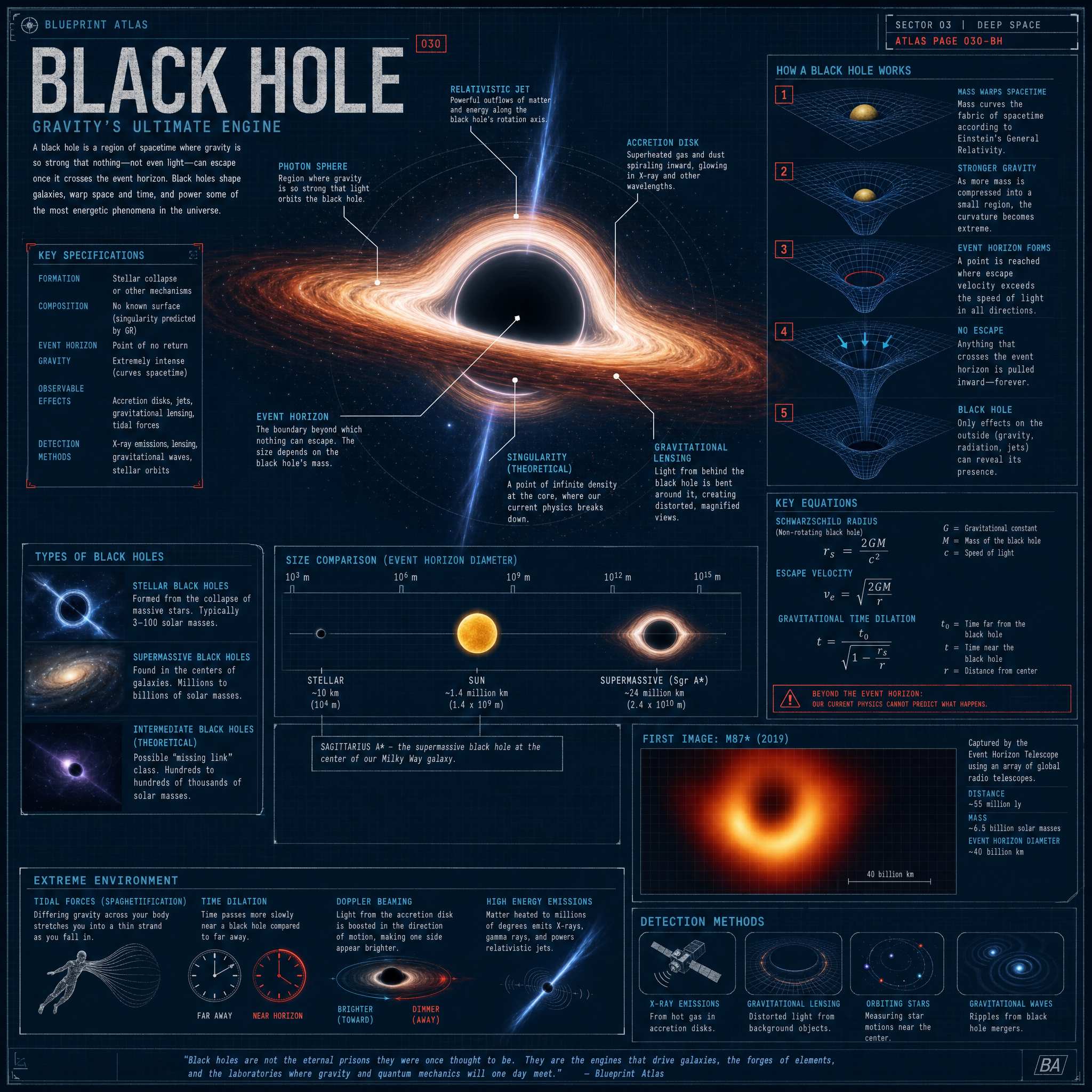
Black Hole
Predicted by general relativity, confirmed by gravitational waves in 2015 and photographed in 2019. The shadow is 2.6 times the event horizon, ringed by light that has orbited the hole one or more times before reaching us.
Sheet 008
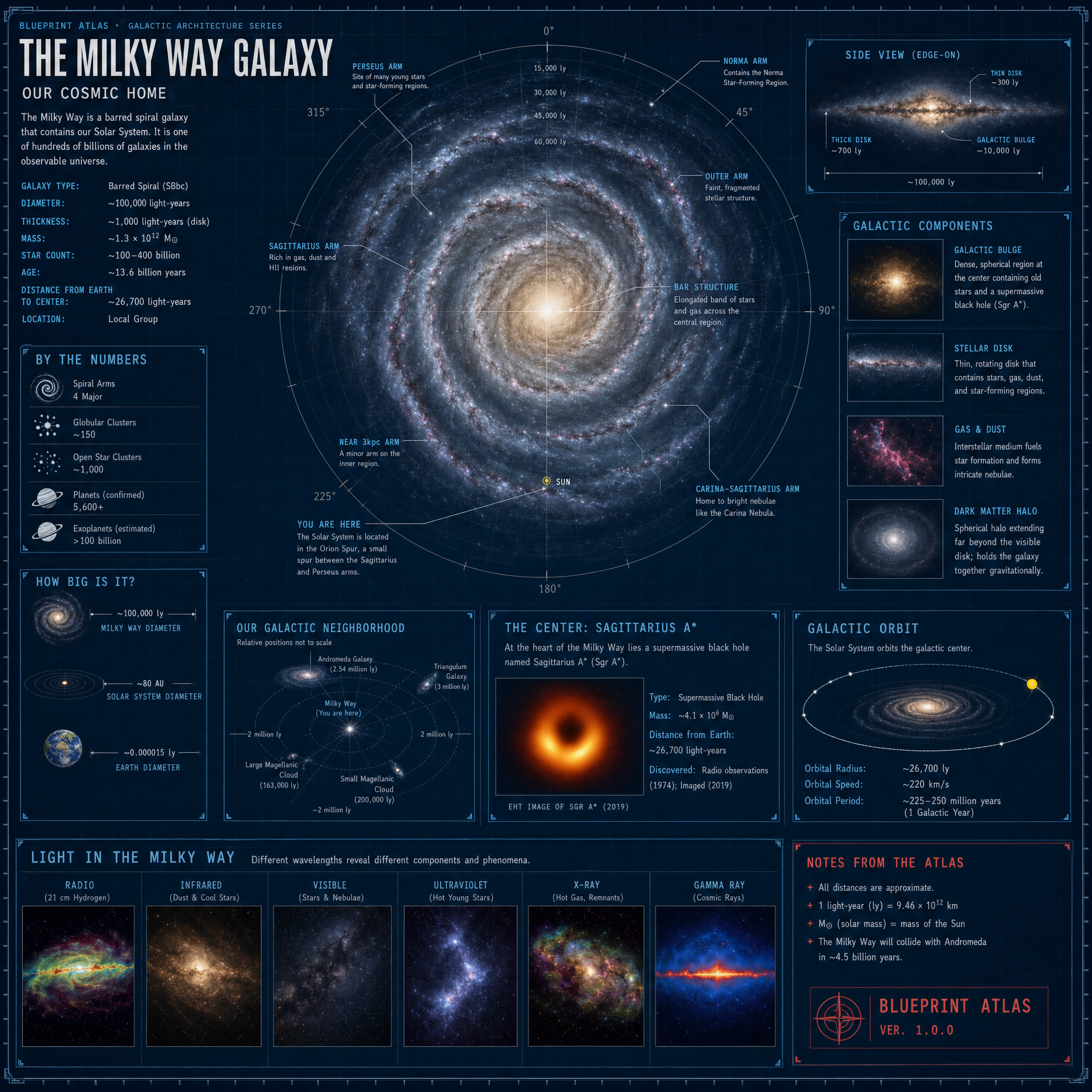
Milky Way Galaxy
A barred spiral about 100,000 light-years across, with four major arms and a supermassive central black hole. The Sun rides in the Orion Spur, two thirds of the way out from the galactic centre.
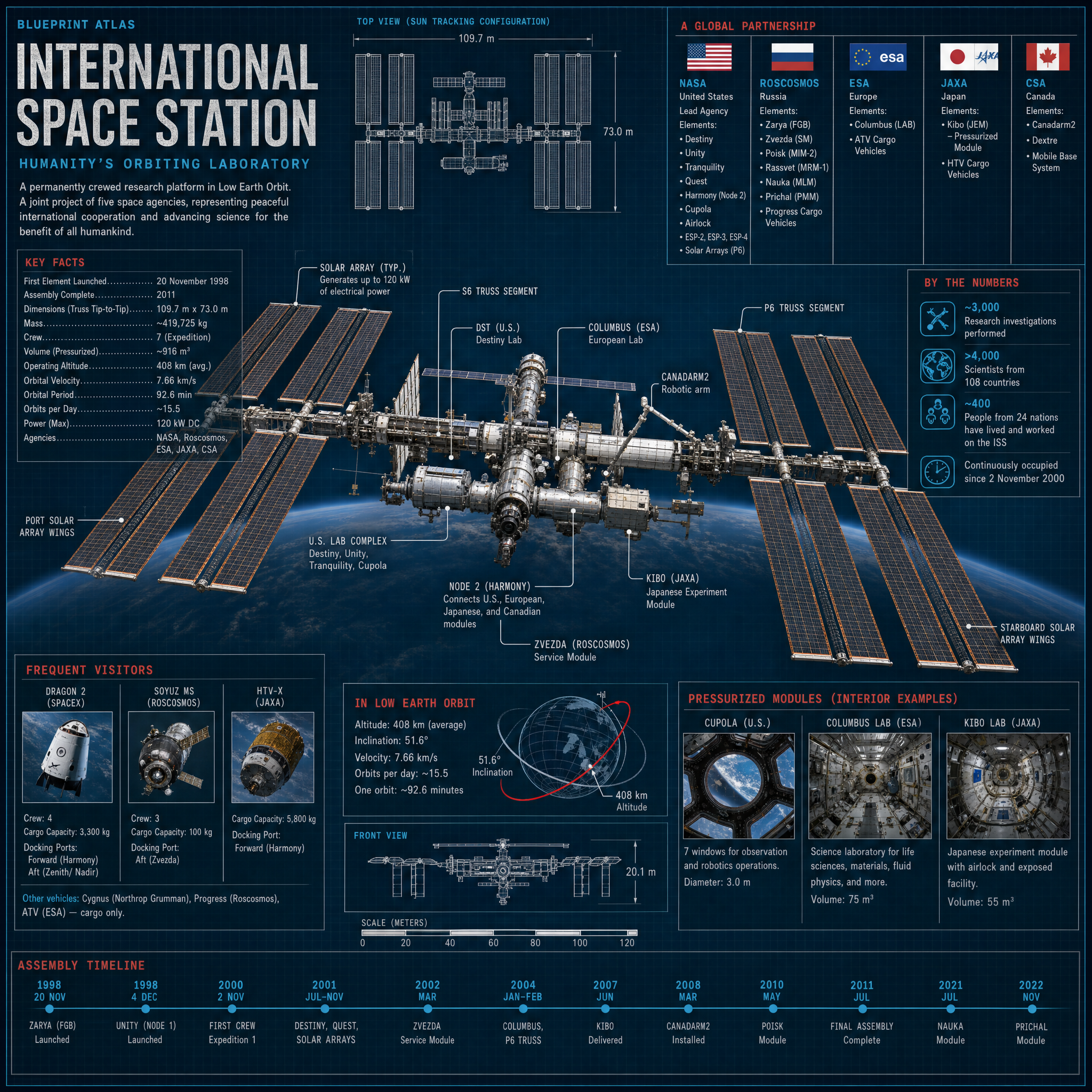
Sheet 009
International Space Station
The largest structure ever assembled in space. Seventeen pressurised modules, 109 metres end to end, orbiting Earth every 93 minutes — 16 sunrises a day for whoever is on board.
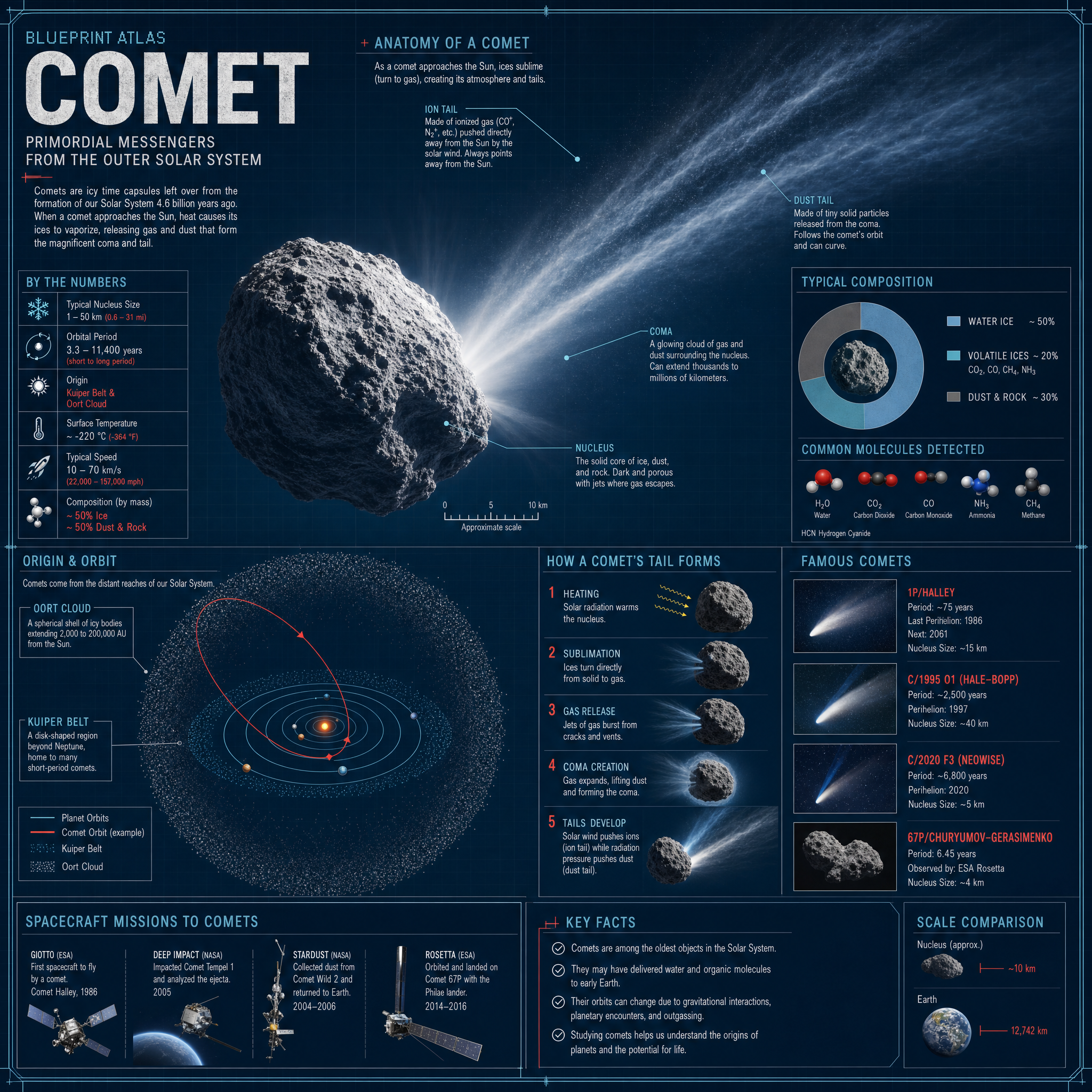
Sheet 010
Comet
As a comet nears the Sun, ices sublime and push out a coma; solar radiation pressure curves the dust tail, while the solar wind strips charged ions into a second, straight blue tail that always points away from the Sun.